You pull away without meaning to. You cancel plans. You read into a partner’s silence and brace for something bad, even when nothing is wrong. You want to feel close to people you love, and you can’t quite get there – and you don’t fully understand why.
This is one of the quieter ways PTSD shows up. Not in nightmares or flashbacks alone, but in the small, daily moments of connection that start to feel unsafe. The nervous system that learned to protect you is still doing its job – it’s just doing that job in the wrong place now.
This page is for people who have noticed PTSD affecting their relationships and want to understand what’s actually happening.
Relationships require vulnerability. They require a baseline of safety – the sense that another person won’t hurt you. When PTSD disrupts that baseline, closeness stops feeling like comfort and starts feeling like risk. The same nervous system that protected you during trauma is now reading ordinary intimacy as a threat signal.
That’s not a character flaw. It’s a symptom. But understanding it as a symptom is the first step toward doing something about it.
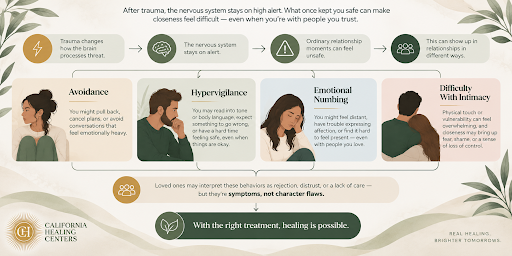
How PTSD Avoidance Shows Up in Relationships
PTSD avoidance in relationships can look like:
- Pulling back from a partner after moments of closeness
- Declining plans, then feeling guilty about it later
- Changing the subject when conversations get emotionally heavy
- Leaving the room, or the house, when conflict arises
- Staying busy as a way to avoid sitting with feelings
- Going quiet for days after an argument – not to punish anyone, but because re-engaging feels impossible
The person doing the avoiding often knows, on some level, that they’re doing it. They may want nothing more than to stay in the room, to hold the conversation, to let someone in. The avoidance isn’t a choice they’re consciously making – it’s the nervous system hitting a circuit breaker.
For partners and family members on the other side, this pattern can feel like rejection. That gap in understanding – between what the person with PTSD is experiencing and what their loved one perceives – is often where relationships take the most damage.
Hypervigilance and Trust in Relationships
This might look like:
- Checking a partner’s messages or whereabouts not out of jealousy, but out of an anxious need to confirm they’re safe and that things are still okay
- Reading a neutral facial expression as anger or disappointment
- Bracing for criticism before it comes, sometimes perceiving it when it wasn’t intended
- Struggling to believe that good things – a stable relationship, a partner who stays – are real and won’t disappear
- Reacting to minor friction as though it’s the beginning of something catastrophic
Trust is built on predictability – the experience that someone does what they say, that the world doesn’t suddenly shift. Trauma breaks that experience. And until the underlying PTSD is addressed, the hypervigilance tends to persist regardless of how trustworthy the people in someone’s life actually are.
This is worth naming directly: the problem isn’t the partner. It’s not a lack of communication skills or an unwillingness to try. It’s a nervous system that learned, for very good reason, not to relax.
Emotional Numbing and Disconnection from Loved Ones
Emotional numbing isn’t the same as not caring. It’s more like a circuit breaker that kicked in during trauma to protect you from being overwhelmed – and never fully switched back off. People describe it in different ways: feeling like they’re watching their life from behind glass; going through the motions of a relationship without being fully present in it; knowing they should feel something but not being able to access it.
In a relationship, this can show up as:
- Difficulty expressing warmth or affection, even toward people you feel warmth toward
- Feeling disconnected during moments that should feel meaningful – anniversaries, milestones, good news
- Going quiet during conversations that require emotional engagement
- Struggling to be comforting when a partner is upset, even when you want to be
Partners and family members often experience this as distance or coldness. That interpretation is understandable, but the person with PTSD usually isn’t choosing to be distant. They’re trying to reach through something they can’t always see or name.
How PTSD Affects Intimacy
This doesn’t mean intimacy becomes impossible. But it often becomes more complicated:
- Physical touch that would otherwise feel comforting can feel activating or intrusive
- Emotional closeness can feel frightening – the closer someone gets, the more there is to lose
- Vulnerability in a relationship can feel identical to vulnerability in the traumatic event – exposed, undefended, at risk
- Shame about past trauma can make it harder to be seen by a partner
Some people with PTSD find they can be close up to a certain point, and then something shuts down. They may describe it as a wall they can’t explain or get past. Others find that intimacy has disappeared entirely in ways that confuse and frighten them.
These are symptoms. They respond to treatment. They are not a verdict on someone’s capacity for love or connection.
When Relationship Difficulties Are a Sign Something Deeper Is Going On
It may be worth looking at PTSD as a factor when:
- The same relational patterns repeat across multiple different relationships
- Reactions to conflict or intimacy feel out of proportion – overwhelming, hard to regulate, accompanied by physical symptoms like a racing heart or difficulty breathing
- There’s a clear shift in how someone functions in relationships after a specific event or period
- Avoidance has escalated over time rather than staying stable
- Someone is trying – genuinely trying to connect, to communicate, to stay – but keeps hitting a wall they can’t explain
When the difficulty isn’t just about this relationship, or this partner, but seems to be following someone across every close relationship they have, the source is usually internal – not situational. That’s often the first signal that there’s something worth treating, not just managing.
Residential treatment addresses PTSD at a level that outpatient therapy alone often can’t reach. When symptoms have become entrenched – when the patterns are years deep, when avoidance has narrowed someone’s world significantly – a structured, immersive environment gives the nervous system the time and safety it needs to genuinely shift.
If what you’re reading here feels familiar – if you’ve been trying to understand why closeness is so hard, or why you keep pulling back from people you want to be close to – that recognition matters. It’s worth taking seriously.
To learn more about how PTSD treatment works and what recovery looks like, visit our page on PTSD treatment in San Diego.