Most people who call us have already spent weeks thinking about whether to call. They’ve researched, they’ve wondered, they’ve put the phone down more than once. One of the things that stops people isn’t doubt about whether they need help – it’s not knowing what actually happens when they show up.
This page answers that. No brochure language. Just an honest account of what residential PTSD treatment at California Healing Centers looks like from start to finish.
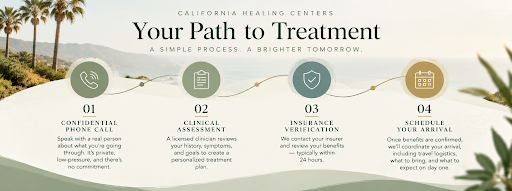
Step 1: Confidential phone call with admissions
You call (858) 868-7707 and speak with an admissions specialist – a real person, not a triage script. The conversation is private, low-pressure, and takes as long as you need. You’ll share what’s been going on, what you’re looking for, and any questions you have. Nobody’s making a decision in that first call. It’s information-gathering on both sides.
Step 2: Clinical assessment
If residential care seems like a good fit, the next step is a clinical assessment. A licensed clinician reviews your history, current symptoms, any medications you’re taking, and what you’ve tried before. This helps the team understand what you’re dealing with specifically – not just “PTSD” as a label, but the way it’s showing up in your life. The assessment is also what allows the team to build a treatment plan that’s actually calibrated to you before you arrive.
Step 3: Insurance verification within 24 hours
Most major insurance plans cover some portion of residential mental health treatment when it’s clinically indicated. Once you’ve completed the assessment, our team contacts your insurer and reviews your behavioral health benefits. You’ll hear back within 24 hours – not in a week. If you want to get a head start, you can verify your insurance coverage directly on our site.
Step 4: Scheduling your arrival
Once benefits are confirmed, the team coordinates your arrival – including logistics, what to bring, what to leave at home, and what to expect on day one. If you’re traveling from out of state or need ground transportation from San Diego International Airport, that can be arranged.
What Your First Day Looks Like
You’ll be welcomed by your admissions coordinator and shown to your private suite. There’s a clear check-in process – intake paperwork, a brief medical review, a meeting with a nurse – but it’s paced so you’re not bombarded. You’ll have time to settle in, get familiar with the space, and have a meal before anything else is asked of you.
That first afternoon, you’ll sit down with a member of your clinical team for an initial session. This is a conversation, not an evaluation. You’re not being assessed – you’ve already been assessed. This meeting is about the clinician getting to know you as a person and beginning to map out what your first week will focus on.
A note on what you won’t experience: no group assignments on day one, no workshop orientation, no schedule packed tight from 7 a.m. Arrival day is intentionally slower. The team understands that getting here takes a lot.
What a Typical Week in Residential PTSD Treatment Involves
A typical week includes a combination of individual therapy sessions, group therapy, and wellness programming. Individual sessions are where most of the clinical work happens – processing traumatic material, working on patterns that formed in response to trauma, learning skills to manage symptoms when they spike. Group sessions offer something different: the experience of being around other people who understand what you’re going through without needing an explanation.
Mornings tend to start with something grounding – yoga, a brief mindfulness practice, or light movement. Afternoons cycle between therapy, specialty programming (somatic work, skills groups), and time that’s genuinely yours. Evenings are quieter.
One thing most people don’t anticipate: the pacing is deliberate. Trauma treatment is not a sprint. The team won’t push you faster than your nervous system can handle, and there’s no expectation that you arrive ready to process. Some of the most important early work is stabilization – building enough safety internally to be able to go deeper.
Stays typically run 30 to 60 days, though some clients stay longer. Length is determined by clinical progress, your own goals, and insurance coverage. You won’t be rushed out before the work is done.
What Therapy Looks Like at CHC
Cognitive Behavioral Therapy (CBT) is the backbone of most treatment plans. It focuses on the relationship between thoughts, feelings, and behaviors – specifically the distorted thought patterns that PTSD can create and reinforce. Therapists use it to help you examine those patterns without re-traumatizing you in the process.
Dialectical Behavior Therapy (DBT) adds a skills layer. DBT was originally developed for people with high emotional intensity, and it translates well to PTSD – particularly for managing emotional flooding, interpersonal difficulties, and the urge to avoid. You’ll likely encounter DBT in both individual and group formats.
Internal Family Systems (IFS) is a model that treats the mind as made up of different “parts” – some protective, some wounded. For trauma survivors, this framework often resonates in ways that more traditional talk therapy doesn’t. It’s slower, gentler, and doesn’t require you to re-live events to make progress.
Brainspotting is a newer, body-based approach that works with where you hold trauma neurologically. It’s different from what most people picture when they think of therapy – more quiet, more internal – and it can reach places that verbal processing alone doesn’t.
Somatic and yoga therapy round out the approach. Trauma is stored in the body, not just in memory, and purely cognitive treatments can miss that. Somatic work and yoga are woven into the schedule specifically to help regulate the nervous system, not just as wellness add-ons.
Your treatment plan will combine several of these, based on what fits your history and what you respond to. Most clients don’t use all of them. You and your therapist build the plan together, and it can shift as you do. For a fuller picture of how all of this fits into residential mental health treatment at CHC, the residential program page has more detail on structure, length of stay, and what a full continuum of care looks like.
What Happens When Treatment Ends
By the time you’re ready to leave, you’ll have a written aftercare plan that specifies the type of ongoing support recommended, the frequency of outpatient therapy, any medication protocols, and crisis resources if things get difficult. You’ll also have a chance to do a final session with your primary therapist – not a goodbye, but a transition.
Most clients leave with a clearer sense of what they need than when they arrived. The work doesn’t end on the last day. But you’ll have more tools than you did before, a better understanding of your own patterns, and a clinical team you can reach out to if questions come up.
Common Questions Before You Arrive
No. Your admission is fully confidential. It doesn’t appear in any public database, and no information is shared with insurers or outside providers without your written consent. Discreet admissions is a core part of how CHC operates – particularly for clients for whom privacy is non-negotiable.
No. You can call directly. A referral from a therapist, psychiatrist, or primary care provider can be helpful for clinical context, but it’s not required to start the process.
The admissions team will give you a specific list when your arrival is scheduled. Generally: comfortable clothing for a stay of several weeks, personal care items, any prescription medications in their original bottles, and items that feel grounding to you. Electronics are typically limited during the first week but aren’t prohibited.
Yes, when clinically appropriate and when you want them to be. Family involvement looks different for every client. Some people want their family updated throughout; others need distance as part of their recovery. The clinical team will discuss this with you directly.
Most people who come to California Healing Centers have tried something else first. That history is actually useful clinical information – it helps the team understand what approaches haven’t served you and why. Prior treatment attempts aren’t a disqualifying factor; they’re part of the picture.
When you’re ready to take the next step, call (858) 868-7707 or reach out through our admissions page. The conversation is confidential, and there’s no obligation. To learn more about the full PTSD treatment program and the conditions we treat, visit our page on PTSD treatment in San Diego.