If you’ve heard about neurofeedback from a friend, a podcast, or your own research, you probably want a straight answer: what is it, and could it help you? At California Healing Centers (CHC), neurofeedback and brain mapping are part of the innovative therapies we offer alongside evidence-based talk therapy and psychiatric care in our Rancho Santa Fe residential program, just north of San Diego.
Neurofeedback isn’t something you’ll find at every residential program. We offer it because many people who come to us, especially those carrying trauma, anxiety, or depression, describe feeling stuck in a brain and body that won’t settle. Neurofeedback gives your clinical team another way to understand what’s happening and gives you a hands-on way to practice calm.
Below, we explain how neurofeedback and brain mapping work, what the research does and doesn’t show, and what to expect if it becomes part of your treatment here.
What Is Neurofeedback Therapy?
Neurofeedback is a type of biofeedback focused on brain activity. Small sensors on your scalp read the electrical activity your brain naturally produces, often called brainwaves, through an electroencephalogram (EEG). Software turns that activity into real-time feedback, usually through a video, a simple game, or sound.
When your brain moves toward a targeted pattern, the feedback responds: the picture brightens or the music plays smoothly. When it drifts, the feedback changes. You don’t have to force anything. Over repeated sessions, the brain learns from that feedback, much like you’d learn any new skill through practice.
Two points tend to put people at ease:
- Nothing is sent into your brain. The sensors only listen. Neurofeedback doesn’t deliver electrical current or magnetic stimulation.
- It’s noninvasive and drug-free. There are no needles, and it doesn’t replace the medication plan you and your psychiatrist agree on.
Neurofeedback has been studied for decades. The research is stronger for some conditions than others, which is why we describe it as evidence-informed and use it as one part of a broader treatment plan rather than a stand-alone fix.
What Is Brain Mapping and How Does It Work?
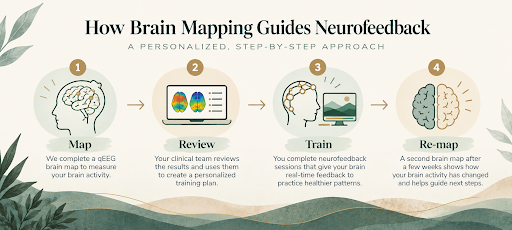
At CHC, brain mapping is the first step, completed when you’re admitted, and it guides your neurofeedback. Clinically, it’s called a quantitative electroencephalogram, or qEEG.
During a brain map, you sit comfortably while sensors record activity across your scalp. The recording typically happens while you rest with your eyes open and then closed. It’s painless and noninvasive. The whole appointment takes about 30 minutes, including setup.
Software then compares your recording with a database of people in your age range. The result is a set of color-coded maps showing where activity runs higher or lower than typical and how different regions of the brain communicate.
At CHC, brain mapping is part of your psychiatric care. Our physician orders it and reviews the report, which goes into your medical record. Your doctor or director of nursing then walks through the results with you, and your psychiatric and clinical teams use them to inform medication decisions and which therapy priorities to focus on first.
Your team uses your brain map in three ways:
- To personalize neurofeedback. The map helps clinicians decide where to place sensors and which patterns to train.
- To add context to your treatment plan. Patterns can line up with what you’re living with, such as a mind that won’t quiet down or trouble concentrating.
- To track change. A second map after about two to three weeks shows how your brain activity has changed.
A brain map isn’t a diagnosis on its own. Your diagnosis comes from a full psychiatric and clinical evaluation, and the qEEG is one more source of information that helps your team tailor care to you.
Insurance and Admissions
What Conditions Does Neurofeedback Help?
At CHC, neurofeedback is available across the conditions we treat when your clinical team believes it’s a good fit. The research is more developed for some conditions than others, and we’ll be honest with you about where your situation falls.
Anxiety and PTSD
Anxiety and trauma can leave the nervous system stuck on high alert. You may feel keyed up, startle easily, or lie awake even when you’re exhausted. Neurofeedback for anxiety and trauma typically focuses on helping the brain practice calmer, more settled states. Studies suggest it may ease hyperarousal for some people, and it pairs naturally with the trauma-focused work at the center of our PTSD treatment program. If worry is your main concern, see how we approach anxiety treatment at CHC.
Depression
Some studies have described recognizable brain-activity patterns in people with depression, including differences between the left and right front of the brain. Neurofeedback treatment for depression is an active area of research with encouraging early findings, though it’s less established than for ADHD. We use it to complement therapy and medication, never to replace them.
ADHD
ADHD has the largest body of neurofeedback research. Many studies have trained brainwave patterns linked to attention and impulse control, and some have found improvements in focus and self-regulation. Results vary, and neurofeedback for ADHD is generally considered a complementary option rather than a substitute for medication or behavioral treatment. For adults whose ADHD overlaps with anxiety, depression, or trauma, it can be one useful part of ADHD treatment at CHC.
OCD and Bipolar Disorder
Research on neurofeedback for OCD and bipolar disorder is more limited. For these conditions, we may use it to support related goals like better sleep, emotional regulation, and easing the anxiety that often comes with them, rather than as a direct treatment for obsessions or mood episodes. Your psychiatric team decides whether it fits, especially while you’re stabilizing on medication.
What to Expect During a Neurofeedback Session at CHC
Neurofeedback happens on-site, so there’s no driving to a separate clinic between therapy sessions. Our Director of Nursing, Elaine Bean, RN, oversees the setup and delivery of neurofeedback. Here’s what a typical course looks like:
- A baseline brain map. When you’re admitted, you complete a qEEG so your team has a clear starting point.
- A walkthrough of your results. Your doctor or director of nursing reviews the report with you in plain language and explains what it means for your treatment.
- Setup. You sit in a comfortable chair and put on a neurofeedback headband with dry sensors and external electrodes. No gel or conductive paste is needed. It takes a few minutes.
- The session. You play simple brain-training games or watch a video for about 20 to 30 minutes. When your brain moves toward the target pattern, the feedback rewards it. Many people find sessions relaxing.
- Three sessions a week. The neurofeedback software builds a training plan from your brain map, and sessions typically happen three times a week.
- A progress map. After about 14 to 21 days, a second brain map shows how your activity has changed. Your psychiatrist and therapist use it to fine-tune your treatment plan.
Most people feel nothing physical during a session. Some notice they feel calmer or more tired afterward. Side effects are uncommon and usually mild, such as temporary fatigue or a headache, and your team watches how you respond.
How Neurofeedback Works Alongside Other Therapies
Neurofeedback is never the whole plan. At CHC, it sits inside a residential program that combines evidence-based, holistic, and innovative care, with trauma as the thread connecting them.
- Talk therapy. A calmer, more regulated nervous system can make it easier to stay present in individual therapy, cognitive behavioral therapy, and dialectical behavior therapy.
- Trauma therapies. Clients doing deep trauma work with eye movement desensitization and reprocessing (EMDR), brainspotting, or internal family systems therapy may find neurofeedback helps them settle between sessions.
- Medication management. Your psychiatric team considers neurofeedback alongside your medications and, where used, pharmacogenomic testing, so every part of your care points in the same direction.
- Holistic practices. Yoga and breathwork also work with the body’s stress response and reinforce the regulation skills you practice in neurofeedback.
Because you live on-site, your team sees how you’re sleeping, eating, and engaging day to day. That means they can adjust your neurofeedback plan as things change rather than waiting for a weekly appointment.
Is Neurofeedback Right for You?
Neurofeedback may be worth discussing with your care team if:
- Your mind won’t slow down, even when you know you’re safe
- Trauma has left you easily startled, on edge, or unable to sleep
- You’ve tried therapy or medication and want another evidence-informed tool
- You want a clearer picture of how your brain is functioning
It isn’t the right fit for everyone. Your clinicians consider factors like seizure history, recent medication changes, and overall stability before recommending it.
At CHC, neurofeedback is part of residential mental health treatment for adults who need more support than weekly therapy can offer but don’t need hospitalization. It isn’t offered as a stand-alone outpatient service. When you call, our admissions team can talk through whether neurofeedback and brain mapping make sense for your goals.
Neurofeedback FAQs
Neurofeedback is used to help the brain practice healthier activity patterns. In mental health care, it’s most often used alongside other treatment for ADHD, anxiety, trauma, and depression.
Sensors read your brainwaves while you play a simple brain-training game or watch a video. When your brain moves toward a target pattern, the feedback rewards it. With repetition, the brain learns from that feedback.
No. Brain mapping (qEEG) is an assessment that records and analyzes your brain activity. Neurofeedback is the training that follows, and your map helps guide it.
No. The sensors only record activity and don’t send anything into your brain. Most people find sessions relaxing.
At CHC, sessions typically happen three times a week, with a progress brain map after about 14 to 21 days. The total number depends on your length of stay and how you respond, and your clinician adjusts the plan along the way.
For most clients, neurofeedback is billed to insurance separately with no additional fee from CHC. Our admissions team can walk you through costs and coverage. Verify your insurance to get started.
Explore Neurofeedback at California Healing Centers
If you’ve been wondering whether neurofeedback could help, you don’t have to figure it out alone. Our admissions team can answer your questions, explain how brain mapping fits into residential care, and check your coverage confidentially. Call (858) 330-4769 or verify your insurance to take the next step.