Deciding whether residential mental health treatment is necessary can feel unclear, especially when someone is already in therapy, taking medication, or trying hard to manage symptoms on their own. Many people do not reach this question because they have stopped caring about recovery. They reach it because the support they have is no longer enough to keep them safe, stable, or functional day to day.
Residential care is usually considered when symptoms are severe enough to disrupt basic routines, relationships, work, sleep, judgment, or personal safety. It can also make sense when someone keeps trying outpatient treatment but continues to decline, relapse into crisis, or lose the ability to function consistently. If you are trying to understand whether that line has been crossed, this page is meant to help you evaluate the situation in practical terms.
This can include people whose anxiety, depression, PTSD, OCD, or related symptoms are no longer staying contained between appointments. It can also include people who are technically still getting through the day, but only with a level of distress, exhaustion, avoidance, or instability that is no longer sustainable. For a fuller overview of the program itself, see residential mental health treatment.
Signs Outpatient Therapy May No Longer Be Enough
Common signs include:
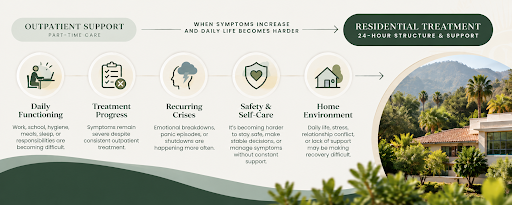
Symptoms are interfering with basic daily functioning
A person may stop keeping up with work, school, hygiene, meals, sleep, bills, childcare, or appointments. Sometimes the decline is obvious. Other times it looks like someone is still showing up, but only barely, with most of their energy going toward getting through the day.
Progress in therapy has stalled despite real effort
Some people are fully engaged in treatment and still not getting better. They attend sessions, follow recommendations, and want relief, but symptoms remain severe or keep returning. That does not mean treatment has failed. It may mean the current level of support is not intensive enough.
Crises are becoming more frequent
Repeated emotional breakdowns, panic episodes, shutdowns, spirals, or urgent calls for help can point to a pattern that is no longer manageable in a weekly therapy format. The issue is not whether every moment is a crisis. It is whether stability between crises is becoming harder to maintain.
Safety is becoming harder to manage outside a structured setting
If someone is struggling to stay safe, making impulsive decisions, neglecting serious symptoms, or needing constant outside monitoring from family or friends, that is a meaningful sign that a more structured environment may be appropriate. This is especially important when judgment, concentration, or emotional regulation has become unreliable.
Home life is no longer supporting recovery
Sometimes the person is willing to do the work, but the environment around them keeps pulling them backward. That may include isolation, overwhelming stress, relationship conflict, lack of routine, or simply not having enough support between appointments. Residential care can create space to stabilize when daily life has become too chaotic for treatment to take hold.
Who May Need Residential Mental Health Treatment
A residential evaluation may be worth considering for someone who:
- Is not functioning consistently in work, school, or home life
- Keeps worsening between outpatient appointments
- Has severe symptoms that dominate most of the day
- Cannot maintain routines related to sleep, meals, hygiene, or medication
- Needs a structured setting to interrupt avoidance, shutdown, or emotional dysregulation
- Has tried outpatient treatment but remains unstable
This question often comes up across several conditions, including anxiety, depression, PTSD, and OCD. The diagnosis matters, but the bigger question is how much the symptoms are affecting safety, stability, and daily functioning.

Examples Of When Residential Care May Be Necessary
One person may be sleeping only a few hours a night, missing work, and becoming unable to manage panic outside the house.
Another may be in therapy for depression, taking medication, and still reaching a point where getting out of bed, showering, eating, and replying to basic messages feels unmanageable most days.
Someone with PTSD may feel so activated, avoidant, or emotionally flooded that treatment cannot gain traction while they are trying to keep up with normal daily demands.
A person with OCD may be spending so much time on compulsions, checking, rumination, or avoidance that the day is being organized around symptoms rather than around life.
In some cases, medication is part of the picture too. If prescriptions need closer evaluation, adjustment, or monitoring, medication management may be part of a broader treatment plan.
Residential Treatment Is Not Only For The “Worst Case”
The better question is not “Is this bad enough compared with someone else?” The better question is “Is the current level of support enough to help this person stay stable and function safely?” If the honest answer is no, then a residential evaluation may be reasonable.
Waiting until someone is in complete collapse can narrow options. Seeking a higher level of care earlier can make treatment more focused and less reactive.
Questions To Ask When Deciding If Residential Treatment May Be Needed
- Is daily life getting smaller because symptoms are taking over more time and energy?
- Is the person becoming less able to function between appointments?
- Has outpatient treatment been consistent, but not sufficient?
- Are family members or loved ones carrying more and more of the burden just to keep things together?
- Is safety, judgment, or self-care becoming harder to trust?
- Does the person need more structure than they can realistically create at home?
If several of those answers are yes, it may be time to explore whether residential treatment is the more appropriate setting.
What Happens Next If You Are Unsure
That process can help clarify whether residential care makes sense now, whether another treatment approach should be adjusted first, and what kind of support would best fit the situation. If symptoms have reached the point where outpatient care no longer seems sufficient, starting with a program-level conversation is often the most practical next step.
Related reading
If you are trying to figure out whether symptoms have reached the point where a more structured level of care is necessary, learn more about residential mental health treatment and what that process looks like.