
You ask your partner if they’re upset with you. They say no. Ten minutes later you ask again, a little differently, because the first answer didn’t settle anything. Or you lie awake replaying a conversation, checking whether you really love them, whether they really love you, whether you’d even know if something were wrong.
OCD rarely stays in one corner of life. For many people, it moves straight into the relationships that matter most, because that’s where the stakes feel highest. From the outside, it can look like insecurity, jealousy, or coldness. Underneath, it’s usually a mind that can’t tolerate uncertainty, trying to make a relationship feel safe the only way it knows how.
Whether you’re the one living with OCD or the partner trying to make sense of it, the patterns below are symptoms, not character flaws. And they often respond to treatment.
Confidential admissions • Residential-only care • 24/7 support
In a relationship, OCD often latches onto what a person cares about most: whether they love their partner enough, whether their partner is the right one, whether they could ever hurt someone they love. Doubt about something that important is hard to leave alone.
Some people experience what’s often called relationship OCD, where obsessions center on the relationship itself or on a partner’s perceived flaws. Others have OCD focused on contamination, harm, or order that spills into shared space, routines, and physical closeness. Either way, the relationship becomes one more place the cycle plays out.
Relationships are rarely the only place it shows up, either. The same loop tends to reach into work, sleep, and daily routines, which is why it helps to understand how OCD affects daily life as a whole.
Reassurance Seeking in OCD Relationships
- Asking “Do you still love me?” or “Are we okay?” many times a day
- Needing a partner to confirm something they’ve already confirmed
- Confessing small thoughts or past events to make sure nothing feels hidden
- Comparing the relationship to friends’ relationships, movies, or past partners
- Checking a partner’s phone, location, or tone of voice for signs of trouble
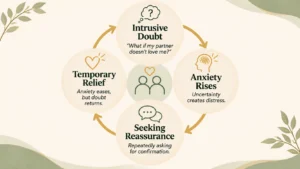
For the person asking, each answer brings a moment of relief. Then the doubt comes back, often stronger. Reassurance works the way any compulsion does: it eases anxiety now and feeds it later.
Partners usually answer out of love. Over time, though, many start to feel exhausted, or like nothing they say is ever enough. That isn’t a sign that either person is failing. It’s a sign the pattern has taken on a job no relationship can do. Clinicians often call a partner’s role in this “accommodation,” and learning to step out of it together is frequently part of treatment.
How OCD Intrusive Thoughts Affect Intimacy
In intimate relationships, intrusive thoughts can take especially painful forms:
- Doubts like “What if I don’t really love them?” that show up during close moments
- Upsetting thoughts about harming a partner, which the person finds horrifying
- Unwanted sexual thoughts that clash with their values or identity
- Contamination fears that make kissing, touch, or sharing a bed difficult
To protect a partner from these thoughts, or to avoid having them at all, many people pull back from physical closeness. A partner may read that as rejection. Often it’s the opposite: the person cares so much that the thought feels unbearable.
Having an intrusive thought doesn’t mean wanting it, believing it, or acting on it. The distress it causes is usually a sign of how sharply it conflicts with who the person actually is.
Avoidance and OCD in Relationships
- Skipping intimacy, dates, or travel that might trigger obsessions
- Steering clear of certain rooms, objects, or routines at home
- Avoiding conversations about the future, like moving in, marriage, or children
- Staying busy or distant so there’s less room for doubt to surface
- Asking a partner to follow rules, such as washing a certain way or keeping things in a set order
In the short run, avoidance can make a day feel calmer. Over months or years, the life a couple shares tends to shrink around OCD’s rules. Partners may find themselves organizing their days around rituals they never agreed to.
How OCD Affects Trust and Communication
Partners face their own bind. Pushing back on a ritual can lead to conflict or a spike in anxiety, while going along with it can feel like the only kind option. Many end up walking on eggshells, unsure whether to reassure, refuse, or say nothing.
Patterns that often strain trust and communication include:
- Conversations that circle back to the same doubt without resolving it
- Arguments that seem to be about one thing but are really about a compulsion
- One partner starting to feel like a caretaker rather than an equal
- Secrecy about how much time rituals actually take
Naming OCD as the problem, rather than either person, tends to be the shift that lets couples talk about it at all.
When OCD in a Relationship Means It's Time to Get Help
- Reassurance seeking, checking, or confessing happens daily and the relief never lasts
- Intimacy or physical closeness has become something one or both of you avoid
- A partner has taken on rituals or rules to keep the peace
- The same doubts have followed you across more than one relationship
- Outpatient therapy hasn’t loosened the cycle, or symptoms have gotten worse
OCD rarely resolves by being reassured or argued away, but it often responds well to the right treatment. Effective care usually focuses on helping someone tolerate uncertainty without performing the compulsion, alongside medication management when it’s clinically appropriate. Partners can be part of that work, learning how to support recovery without feeding the cycle.
For some people, weekly therapy is enough. For others, symptoms are entrenched enough that a more structured setting makes the difference. Residential mental health treatment offers 24/7 support, regular psychiatric care, and distance from the routines OCD has built into home life, which can make new patterns easier to practice.
If what you’ve read here feels familiar, that recognition matters. To learn how California Healing Centers approaches OCD care, visit our page on OCD treatment in San Diego.
Frequently Asked Questions About OCD and Relationships
OCD can turn a relationship into one more place the obsession-compulsion cycle plays out. It often shows up as repeated reassurance seeking, intrusive doubts about love or attraction, avoidance of intimacy, and rules or rituals a partner gets drawn into. Over time, these patterns can strain trust, communication, and closeness for both people.
Reassurance seeking is a compulsion. It means repeatedly asking for, checking, or confirming something to ease a doubt, such as asking a partner whether they still love you. The relief tends to be brief, and the doubt usually returns stronger, which keeps the cycle going.
Not as a separate diagnosis. Relationship OCD is a common name for OCD in which obsessions focus on a relationship or a partner, such as constant doubt about whether the relationship is right. It’s diagnosed and treated as OCD.
Not indefinitely. Reassurance usually helps for a moment and makes the cycle stronger over time. That doesn’t mean withdrawing support. Many couples work with a clinician on a plan to reduce reassurance gradually and kindly, so the partner with OCD can build their own tolerance for uncertainty.
Yes, many do. With effective treatment, the person with OCD can learn to respond to intrusive thoughts without performing compulsions, and partners can learn how to support recovery without feeding the cycle. Naming OCD as the shared problem is often the first step.
Often, yes. With the client’s consent, family therapy can help partners understand OCD, recognize accommodation, and agree on how to respond to rituals and reassurance requests. At California Healing Centers, family involvement is shaped around each client’s treatment plan.
Related Reading
All three are planned November pieces (NV-9, NV-2, NV-6), not live yet. Kept per the Nov 3 rule allowing temporary 404s.