
PTSD doesn’t stay in the past. It follows you into the office, into bed at night, into the middle of a conversation that has nothing to do with what happened to you. The diagnostic criteria describe intrusion, avoidance, negative cognition, and hyperarousal – but what those categories actually look like on a Tuesday is something else entirely. A meeting you can’t follow because your mind keeps sliding. A partner asking what’s wrong and not being able to explain it. A body that won’t settle even when the house is quiet.
This page is for people who already know something is off and want to understand what PTSD is doing – specifically – to their daily life. Not a list of symptoms. A look at how those symptoms land in the real places you live and work.
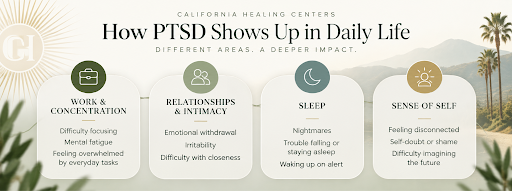
Concentration breaks in ways that feel personal rather than clinical. You read the same paragraph three times and retain nothing. A colleague’s raised voice in the next room pulls you completely out of a task. You walk into a meeting prepared and find you can’t track what’s being said. This is not distraction in the ordinary sense – it’s a brain that has learned to allocate attention to anything that could be a threat, which means it has less of it for everything else.
Deadlines pile up, not because the work itself is beyond you, but because starting it requires a baseline of calm that isn’t always available. Emails sit unanswered. Projects stall midway. Some people in this position are described by managers as disengaged or inconsistent – which adds a layer of professional anxiety on top of everything else.
The hypervigilance piece is less obvious to others but exhausting from the inside. Scanning the room when you walk in. Positioning yourself near an exit. Reading facial expressions for signs of irritation before anyone has said a word. That constant background processing drains the same cognitive resources that concentration requires. By the end of a full workday, many people with PTSD describe a level of fatigue that doesn’t correspond to how much they actually accomplished – because most of the effort went elsewhere.
How PTSD Affects Relationships and Intimacy
Emotional numbing – one of PTSD’s less-discussed features – makes closeness feel inaccessible even when you want it. You’re present at dinner, there for the conversation, and yet somehow not fully there. Partners describe it as talking to someone who has gone somewhere else. Children notice it as a parent who seems distracted even when there’s nothing to be distracted by. The person with PTSD often knows something is missing but can’t locate it or pull it back.
Irritability creates a different problem. Responses that feel internally proportionate – a flash of anger at a noise, a cold reaction to being touched unexpectedly – land on other people as outsized and frightening. Trust erodes in both directions. The person with PTSD starts bracing for their own reactions; the people around them start bracing too.
Intimacy – physical and emotional – often recedes. Touch can trigger. Vulnerability requires a felt sense of safety that hypervigilance actively prevents. Sexual intimacy in particular is an area that many people with PTSD avoid discussing even in therapy, and yet it’s one of the places where the condition quietly takes the most.
For a deeper look at how these patterns unfold in partnerships and family life, see our page on how PTSD affects relationships.
How PTSD Disrupts Sleep
The most discussed form is nightmares – vivid, often narrative re-enactments of the trauma or situations adjacent to it. But the disruption often begins before sleep is even achieved. Hypervigilance keeps the nervous system on alert in the hours most people use to wind down. Sounds that would be background noise in the daytime become potential threats. The quiet of a dark room can feel more dangerous than a busy one, because there’s less environmental information to process – and the system fills the gap with its own.
Some people with PTSD describe lying awake for hours, monitoring. Others fall asleep quickly and wake at 2 or 3 a.m. with a heart rate already elevated, sometimes from a dream they can’t quite recall, sometimes for no reason they can identify. Sleep medication addresses the falling asleep part but often doesn’t reach the underlying hyperarousal that’s driving the pattern.
Daytime functioning in this state is genuinely impaired. Reaction times slow. Emotional responses are harder to modulate. Small frustrations feel larger. Our blog post on how PTSD disrupts sleep goes further into the nightmare component specifically – including what the clinical literature says about why trauma processes during REM and how that plays out in recurring dreams.
How PTSD Changes Your Sense of Self
Part of what happens is the accumulation of evidence. You used to be patient and now you snap. You used to be reliable at work and now you miss things. You used to feel close to the people you love and now there’s a distance you can’t explain or close. Each of these becomes a data point your mind files under “what I’m like now” – a revised identity built from the damage, rather than from who you were before it or who you could be.
The sense of a foreshortened future – one of the criteria in the diagnostic picture – is related. It’s not always experienced as active despair. More often it presents as a quiet difficulty imagining forward: planning next year, picturing a relationship improving, believing that something could be substantively different. The future feels somehow foreclosed, not by a conscious belief but by a background absence of imagination for it.
Shame compounds this. Many people with PTSD carry the belief that their response to what happened was a failure rather than a natural consequence of an overwhelming event. This is particularly common in people who have told themselves – or been told by others – that they should be over it by now. The gap between where they thought they’d be and where they are gets interpreted as a personal defect rather than a symptom of a treatable condition.
High-Functioning PTSD: When You Seem Fine but Aren't
The external competence is real. So is the internal cost. High-functioning PTSD tends to involve a significant expenditure of energy on control – on managing responses, suppressing reactions, maintaining the appearance of steadiness. Work and performance often stay intact because they provide structure and a legible identity. The private life is where the symptoms surface: in sleep, in intimacy, in the moments when there’s nothing to perform.
The risk in this pattern is that the people most affected by it are the least likely to seek help, because they can point to the things that are still working as evidence that they’re fine. And the people around them – seeing the functioning but not the internal experience – often agree. Significant damage can accumulate over years before the gap becomes impossible to maintain.
It’s also worth naming that high-functioning PTSD often means symptoms that don’t match the template people expect. No flashbacks. No obvious avoidance. Just a persistent exhaustion, a flatness in relationships, a sense of going through motions – and a private knowledge that something is wrong that has never been fully named.
When Daily Life Disruption Means It's Time to Get Help
When work performance has become genuinely inconsistent – not because of the work itself but because concentration and stability are unavailable. When relationships have narrowed because the effort required to maintain them exceeds what’s left after managing symptoms. When sleep has been disrupted for months, and the downstream effects are accumulating. When the sense of who you are before the trauma feels like a different person – one you’re not sure you can get back to.
These are not signs of weakness or failure to manage. They are signs that the nervous system is doing something it cannot stop doing on its own, and that the treatment required to interrupt that pattern is more than self-management can provide.
Residential treatment is one option for people whose daily life disruption has reached the point where outpatient support – a weekly therapy session – doesn’t match the scope of what’s happening. Structured, full-time care allows the nervous system to be addressed in depth, over time, without the constant re-triggering that comes from continuing to manage symptoms inside the life they’re disrupting.
If what you’ve read here maps to what your life has looked like, a conversation with a clinician is the right next step. California Healing Centers offers residential PTSD treatment in San Diego – a structured, private program built around the needs of people who have been managing for a long time and are ready for something more.