
If you’re researching trauma therapies, you’ve probably come across two approaches that are frequently recommended: Brainspotting and Eye Movement Desensitization and Reprocessing (EMDR).
Both are designed to help people process distressing experiences that continue to affect their emotions, relationships, and daily lives. Both recognize that trauma is stored not only in conscious memory but also in the nervous system. And both can be highly effective when delivered by trained clinicians.
Where they differ is in how they access and process traumatic experiences.
If you’ve been comparing brainspotting vs EMDR, you may be hoping to determine which therapy is “better.” In practice, experienced clinicians rarely think about it that way. The better question is which approach best fits your history, current symptoms, and therapeutic needs.
For individuals seeking comprehensive trauma treatment, brainspotting therapy is one of several evidence-based modalities that may be incorporated into an individualized treatment plan. At California Healing Centers in Rancho Santa Fe, clinicians provide both Brainspotting and EMDR within a residential treatment setting, allowing therapy to be selected based on clinical need rather than provider limitations.
What Brainspotting Is
Brainspotting is a trauma-focused therapy developed by Dr. David Grand in 2003.
The approach is based on the observation that specific eye positions appear to correspond with areas of stored emotional and physiological activation. During treatment, the therapist helps identify a “brainspot”—a point in the client’s visual field that is associated with heightened emotional or physical responses.
Rather than repeatedly talking through every detail of a traumatic experience, the client maintains focus on that eye position while paying attention to thoughts, emotions, and body sensations as they naturally arise.
The goal is to access deeper, subcortical processing systems that may not be fully reached through traditional talk therapy alone.
Sessions often include:
- Mindful awareness
- Attention to body sensations
- Emotional processing
- Extended periods of quiet reflection
- Therapist attunement and observation
- Gradual nervous system regulation
Many clients describe Brainspotting as a therapy that allows the brain to process experiences with relatively little direction from the therapist.
What EMDR Is
Eye Movement Desensitization and Reprocessing (EMDR) was developed by Dr. Francine Shapiro in the late 1980s and is one of the most extensively researched trauma therapies available.
EMDR follows a structured eight-phase treatment protocol.
During reprocessing, clients briefly recall distressing memories while simultaneously engaging in bilateral stimulation, which may include:
- Guided eye movements
- Alternating taps
- Alternating sounds
The therapist periodically checks in as the brain naturally reorganizes and integrates traumatic memories.
Unlike traditional exposure therapy, EMDR is not designed to repeatedly relive traumatic events. Instead, it aims to reduce the emotional intensity attached to those memories while helping clients develop healthier beliefs about themselves.
How They Work Differently
Although both therapies target trauma and nervous system regulation, they take different paths to get there.
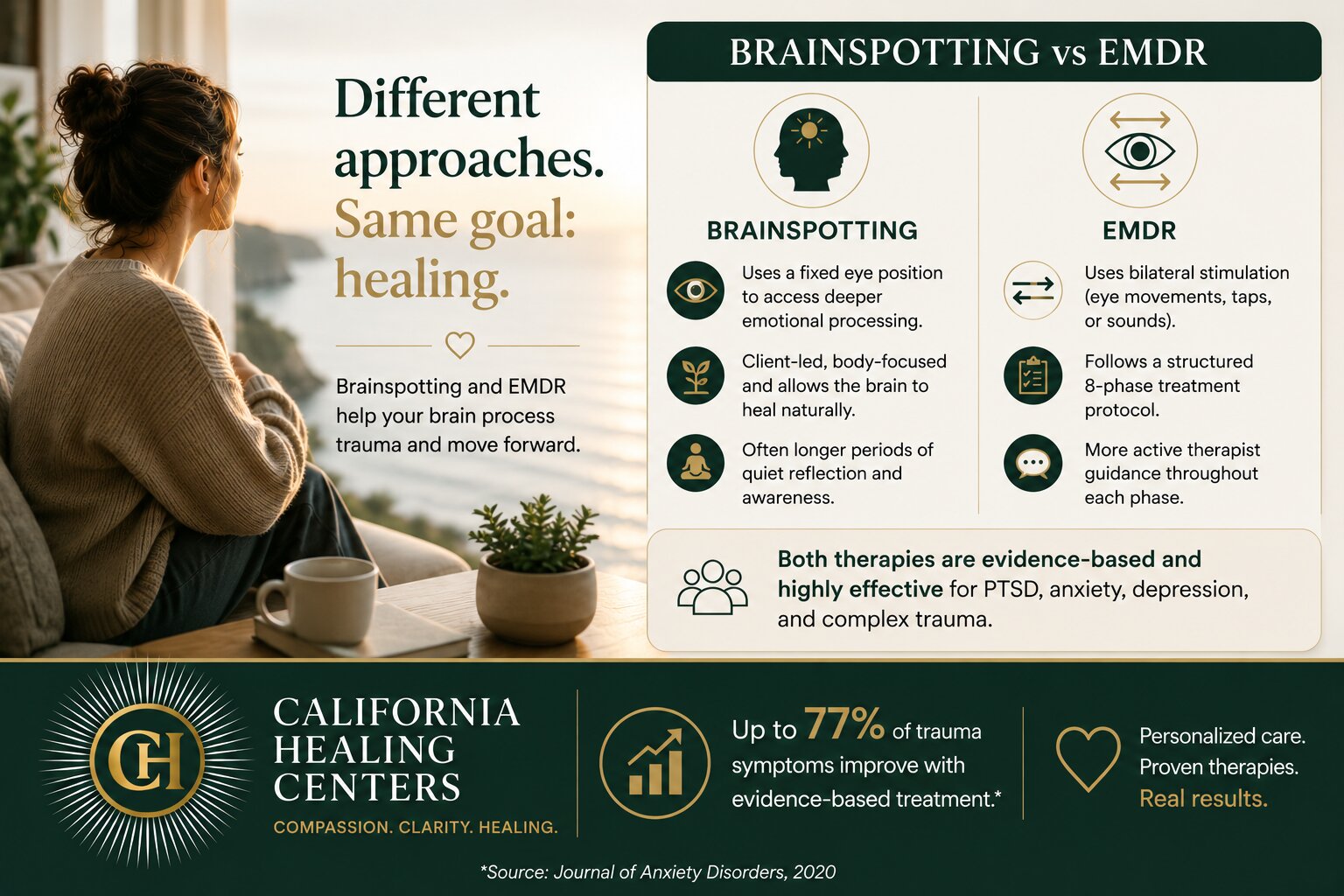
Brainspotting |
EMDR |
|---|---|
| Uses a fixed eye position associated with emotional activation | Uses rhythmic bilateral stimulation |
| Less structured session format | Follows a standardized eight-phase protocol |
| Client-led processing | Therapist-guided protocol |
| Strong emphasis on body awareness | Integrates thoughts, emotions, body sensations, and cognition |
| Therapist follows the client’s internal process | Therapist actively directs each stage of treatment |
| Often longer periods of quiet processing | More structured dialogue throughout sessions |
Neither approach is inherently superior.
Each offers distinct advantages depending on the individual.
How They Are Similar
Despite their differences, Brainspotting and EMDR share many foundational principles.
Both therapies:
- Are designed to help process traumatic memories
- Recognize the connection between trauma and the nervous system
- Extend beyond traditional talk therapy
- Incorporate awareness of physical sensations
- Aim to reduce emotional distress associated with difficult experiences
- Help clients develop healthier emotional responses over time
- Are delivered by specially trained clinicians
Both therapies may be appropriate for conditions such as:
- Post-traumatic stress disorder (PTSD)
- Complex trauma
- Anxiety disorders
- Panic symptoms
- Depression related to trauma
- Grief
- Performance anxiety
- Certain phobias
Neither therapy is simply about talking through painful memories.
Instead, both are designed to help the brain process experiences that have remained emotionally “stuck.”
Which May Suit You?
Choosing between Brainspotting and EMDR is rarely about finding the universally “better” therapy.
Instead, clinicians consider several factors when recommending one approach over another.
You may prefer Brainspotting if…
You appreciate a more open-ended therapeutic experience.
Brainspotting may appeal to individuals who:
- Feel overwhelmed by highly structured therapy
- Notice strong physical responses to stress or trauma
- Have difficulty putting emotions into words
- Value slower, internally guided processing
- Respond well to mindfulness and body awareness
Some clients find that Brainspotting allows deeper emotional processing with fewer interruptions, making it particularly helpful for complex trauma or experiences that feel difficult to explain verbally.
You may prefer EMDR if…
You appreciate structure and clearly defined treatment phases.
EMDR may be a good fit for people who:
- Prefer a predictable therapeutic process
- Like measurable treatment progression
- Want to target specific traumatic memories
- Feel comfortable with active therapist guidance
- Benefit from structured cognitive work alongside emotional processing
Because EMDR follows a standardized protocol, some individuals find it reassuring to understand what each phase of treatment is designed to accomplish.
Sometimes both therapies are appropriate
This is one of the advantages of receiving care at a center that offers multiple trauma-focused therapies.
Rather than trying to make every client fit one treatment model, clinicians can recommend the approach—or combination of approaches—that best matches the person’s symptoms, treatment goals, and progress.
In some cases, therapy plans evolve over time as clients respond to treatment.
Why the Therapeutic Relationship Still Matters Most
People often focus on comparing therapy techniques.
Research and clinical experience consistently show that the quality of the therapeutic relationship also plays a major role in treatment outcomes.
A skilled clinician considers:
- Your trauma history
- Current symptoms
- Emotional regulation abilities
- Readiness for trauma processing
- Personal preferences
- Treatment goals
The choice of therapy is important, but so is the expertise of the clinician delivering it and the broader treatment environment supporting your recovery.
What to Expect at California Healing Centers
California Healing Centers provides individualized residential mental health treatment for adults experiencing trauma-related conditions and other complex mental health concerns.
Because the clinical team offers both Brainspotting and EMDR, treatment decisions are guided by what is most appropriate for each client rather than by a single therapeutic specialty.
Clients may receive care that includes:
- Comprehensive psychiatric evaluation
- Individual psychotherapy
- Brainspotting when clinically indicated
- EMDR when appropriate
- Cognitive Behavioral Therapy (CBT)
- Dialectical Behavior Therapy (DBT)
- Medication management when needed
- Group therapy
- Trauma-informed care
- Holistic wellness practices
- Individualized aftercare planning
Located in Rancho Santa Fe in San Diego County, California Healing Centers provides a residential environment where clients can engage in intensive trauma treatment without the distractions of everyday responsibilities.
The residential setting also allows clinicians to monitor progress closely and adjust therapeutic approaches as recovery unfolds—something that is often more difficult in traditional outpatient care.
Choosing the Right Therapy Starts with the Right Assessment
When comparing Brainspotting and EMDR, it’s natural to want a simple answer about which therapy works best.
In reality, the most effective treatment is the one that matches your individual needs.
Some people thrive with the structure and protocol of EMDR.
Others respond more naturally to the flexible, body-centered approach of Brainspotting.
Many benefit from access to both as part of a comprehensive treatment plan.
Rather than choosing a therapy first and hoping it fits, the best starting point is a thorough clinical assessment with professionals who can recommend the most appropriate approach based on your symptoms, history, and goals.
At California Healing Centers, that individualized approach allows treatment to be tailored to the person—not the therapy.
Frequently Asked Questions
What is the difference between Brainspotting and EMDR?
Brainspotting uses a fixed eye position to access areas of emotional activation while encouraging internally guided processing. EMDR uses bilateral stimulation within a structured eight-phase protocol to help the brain reprocess distressing memories. Both are evidence-based trauma therapies but differ in how sessions are conducted.
Which is better, Brainspotting or EMDR?
Neither therapy is universally better. The most appropriate approach depends on your trauma history, symptoms, preferences, emotional regulation, and treatment goals. An experienced clinician can help determine which therapy is likely to be the best fit.
Which should I choose?
Rather than choosing based on internet comparisons, it’s helpful to undergo a comprehensive clinical assessment. A provider who offers both therapies can recommend the approach that best matches your individual needs instead of being limited to a single treatment modality.
Can you receive both Brainspotting and EMDR?
Yes. In some treatment settings, clinicians may incorporate both therapies at different stages of recovery when clinically appropriate. The decision depends on your progress, therapeutic goals, and overall treatment plan.