You pick up a kitchen knife to prepare dinner, and a disturbing thought flashes through your mind.
“What if I hurt someone?”
You’re holding your child and suddenly wonder:
“What if I lose control?”
The thought feels so shocking that you immediately put distance between yourself and the object—or even the person—you love most.
If you’ve been searching for harm OCD, there’s a good chance you aren’t looking for permission to ignore these thoughts. You’re looking for an explanation for why they happen at all.
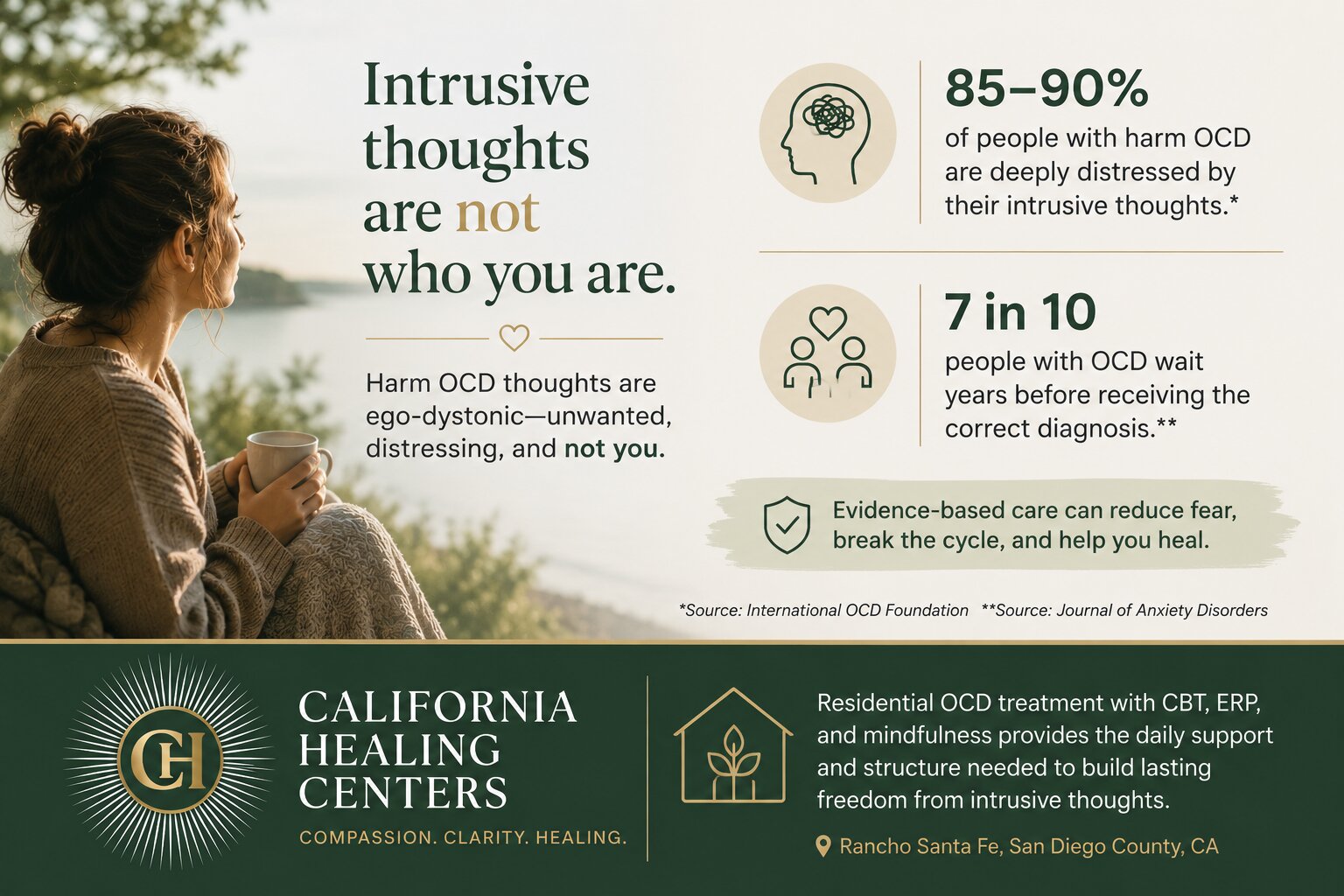
One of the most important things to understand is this: people with harm OCD are typically deeply distressed by their intrusive thoughts precisely because those thoughts are completely inconsistent with their values, intentions, and identity. Mental health professionals describe these thoughts as ego-dystonic—they feel unwanted, frightening, and fundamentally “not me.”
For individuals whose intrusive thoughts have become overwhelming or are interfering with daily life, evidence-based OCD treatment can help reduce the cycle of fear and compulsions that keeps OCD going. At California Healing Centers in Rancho Santa Fe, treatment includes therapies such as Cognitive Behavioral Therapy (CBT) and Exposure and Response Prevention (ERP), delivered within a residential setting for people who need more intensive support.
What Harm OCD Is
Harm OCD is a subtype of obsessive-compulsive disorder characterized by persistent, unwanted intrusive thoughts, images, or urges involving accidental or intentional harm.
These thoughts may involve:
- Hurting someone you love
- Hurting a stranger
- Accidentally causing injury
- Losing control
- Harming yourself despite not wanting to die
- Making a catastrophic mistake that injures someone else
The presence of these thoughts does not reflect a person’s character or intentions.
In fact, the opposite is usually true.
People with harm OCD often place an exceptionally high value on protecting others. Because these values matter so deeply, intrusive thoughts about causing harm become especially frightening.
The problem is not the thought itself.
The problem is the meaning OCD attaches to the thought.
Common Harm OCD Symptoms
Although experiences vary, many people with harm OCD recognize patterns such as:
- Sudden intrusive violent images
- Fear of losing control
- Extreme guilt after unwanted thoughts
- Avoiding situations that trigger intrusive thoughts
- Constantly monitoring thoughts
- Repeatedly seeking reassurance
- Difficulty trusting themselves
- Persistent anxiety around everyday objects
These thoughts often appear without warning and may feel incredibly vivid.
Importantly, vivid thoughts are not evidence that someone wants to act on them.
Intrusive thoughts are common across the general population. In OCD, however, they become “sticky,” leading the brain to repeatedly question their meaning.
Common Obsessions in Harm OCD
Obsessions are recurring intrusive thoughts, images, or urges that create significant anxiety.
Examples may include:
- “What if I stab someone while cooking?”
- “What if I push someone into traffic?”
- “What if I lose control and hurt my child?”
- “What if I accidentally poison someone?”
- “What if having this thought means I’m dangerous?”
- “What if I secretly want this to happen?”
Many people become frightened not only by the content of the thoughts but by the fact that they continue returning despite every effort to eliminate them.
OCD exploits uncertainty.
The more someone tries to become completely certain they would never act on the thought, the stronger the obsessive cycle often becomes.
Common Compulsions (Often Mental)
Unlike some forms of OCD that involve visible rituals, harm OCD frequently includes mental compulsions, which is why it often overlaps with what many people informally call “Pure O.”
Although the term Pure O suggests obsessions without compulsions, most people experiencing these symptoms are performing compulsions internally rather than outwardly.
Common compulsions include:
Mental reviewing
Repeatedly replaying situations to prove nothing harmful happened.
Reassurance seeking
Asking loved ones questions such as:
- “Do you think I’d ever do something like that?”
- “Do I seem dangerous?”
Thought checking
Constantly evaluating whether a thought felt voluntary or unwanted.
Avoidance
Avoiding:
- Knives
- Driving
- Being alone with children
- Cooking
- Certain public places
Mental reassurance
Repeating statements internally to convince yourself that you’re a good person.
Although these behaviors temporarily reduce anxiety, they unintentionally strengthen OCD by teaching the brain that the intrusive thoughts require urgent attention.
Why Harm OCD Is Not a Danger Signal
This is often the greatest fear people bring to treatment.
“If I’m having these thoughts, what if they mean something?”
One of the defining characteristics of harm OCD is that the thoughts are ego-dystonic.
They are unwanted.
They are distressing.
They conflict with the person’s beliefs, morals, and intentions.
Someone with harm OCD is typically frightened by the possibility of causing harm—not motivated by it.
The anxiety comes from desperately wanting reassurance that the thoughts are meaningless.
This is fundamentally different from having a genuine desire to harm another person.
Recognizing this distinction is an important part of understanding why evidence-based OCD treatment focuses on changing a person’s relationship with intrusive thoughts rather than trying to eliminate thoughts altogether.
If intrusive thoughts are accompanied by an actual desire or intention to harm yourself or someone else, that is a different clinical situation and should be evaluated promptly by a qualified mental health professional or emergency services if there is an immediate risk. Harm OCD itself is characterized by unwanted, fear-provoking thoughts rather than intent.
How CBT, ERP, and Mindfulness Treat Harm OCD
The good news is that harm OCD is highly treatable.
The most effective treatments do not try to convince people that intrusive thoughts will never occur.
Instead, they help reduce the fear attached to those thoughts.
Cognitive Behavioral Therapy (CBT)
CBT helps identify unhelpful beliefs that maintain OCD, including:
- Overestimating danger
- Inflated responsibility
- Intolerance of uncertainty
- Thought-action fusion (believing that having a thought makes it more likely to happen or reflects intent)
Clients learn healthier ways of responding to intrusive thoughts without becoming trapped in repetitive analysis.
Exposure and Response Prevention (ERP)
ERP is considered the gold standard behavioral treatment for OCD.
With guidance from a trained therapist, clients gradually face situations that trigger obsessive fears while resisting compulsive responses.
For harm OCD, this may involve carefully designed exposures that help individuals learn they can experience intrusive thoughts without performing reassurance, checking, or avoidance rituals.
Over time, anxiety naturally decreases, and the thoughts lose much of their emotional power.
Mindfulness
Mindfulness teaches people to notice intrusive thoughts without assigning meaning to them.
Instead of asking, “Why did I have this thought?”, individuals learn to acknowledge its presence and allow it to pass without engaging in the OCD cycle.
For individuals whose symptoms significantly interfere with work, relationships, or daily functioning, residential treatment can provide a level of consistency that weekly outpatient sessions may not. At California Healing Centers, clients participate in daily therapeutic work, including CBT and ERP, within a structured environment that allows exposures, skills practice, and clinical support to continue throughout the day rather than being limited to a single therapy appointment each week.
Other OCD Subtypes
Although harm OCD is one of the better-known OCD presentations, obsessive-compulsive disorder can center on many different fears.
Other common subtypes include:
- Contamination OCD
- Checking OCD
- Symmetry and ordering OCD
- Relationship OCD (ROCD)
- Sexual orientation OCD (SO-OCD)
- Religious or scrupulosity OCD
- Health OCD
- Existential OCD
People may experience features of more than one subtype, and themes can change over time.
Regardless of the specific obsession, the underlying OCD cycle remains similar: intrusive thoughts create anxiety, compulsions provide temporary relief, and the cycle repeats.
Recovery Begins by Changing the Relationship with the Thoughts
One of the hardest parts of harm OCD is believing that the thoughts say something meaningful about who you are.
In reality, the distress those thoughts cause is often evidence of how strongly they conflict with your values.
You are not defined by an intrusive thought.
You are also not alone.
With evidence-based treatment—including CBT, ERP, and appropriate clinical support—it is possible to reduce the fear surrounding intrusive thoughts and reclaim the parts of life that OCD has gradually narrowed.
Recovery does not require never having another intrusive thought.
It involves learning that you no longer have to believe, analyze, or obey every one that appears.
Frequently Asked Questions
What is harm OCD?
Harm OCD is a subtype of obsessive-compulsive disorder characterized by persistent, unwanted intrusive thoughts or images about harming oneself or others. These thoughts are ego-dystonic, meaning they are inconsistent with the person’s values and create significant distress rather than desire.
Is harm OCD dangerous?
Harm OCD itself does not mean a person is dangerous. People with harm OCD are typically frightened by their intrusive thoughts and actively try to avoid causing harm. The thoughts are unwanted and distressing, which distinguishes them from genuine intent to act.
How is harm OCD different from Pure O?
Harm OCD refers to the specific theme of intrusive thoughts involving harm. “Pure O” is an informal term used to describe OCD presentations in which compulsions are primarily mental rather than visible. Many people with harm OCD engage in mental compulsions such as reassurance, reviewing memories, or checking their thoughts, which is why the two often overlap.
Can harm OCD be treated?
Yes. Harm OCD responds well to evidence-based treatment, particularly Cognitive Behavioral Therapy (CBT) with Exposure and Response Prevention (ERP). Many people also benefit from mindfulness-based strategies and, in some cases, medication as part of a comprehensive treatment plan.