
Most high-functioning people don’t fear treatment because they think it’s weak.
They fear it because they think it will interrupt the system they built to survive.
The packed calendar. The constant motion. The ability to answer emails while emotionally unraveling in private. The late nights. The overstimulation. The caffeine. The controlled chaos.
For a while, that pace can almost look impressive from the outside.
Until your body starts sending invoices your nervous system can’t pay anymore.
That’s usually when people start quietly searching questions like:
“What is the daily schedule actually like in residential mental health treatment?”
Not because they’re curious.
Because they’re trying to calculate whether they can tolerate stepping away from the life that’s slowly exhausting them.
If that’s where you are right now, you should know something important:
Most people imagine treatment as far more restrictive and clinical than it actually feels.
At our residential treatment program, the structure is not there to control you. It’s there to create enough stability for your brain and body to finally stop sprinting for a minute.
And for high-functioning people especially, that can feel both terrifying and relieving at the same time.
The First Morning Usually Feels Unnatural
Not because anything dramatic is happening.
Because nobody’s demanding something from you immediately.
That alone can feel deeply uncomfortable for people who are used to operating in constant survival mode.
Most mornings inside live-in care begin calmly:
- Breakfast
- Medication support if needed
- Morning reflection or check-ins
- Journaling
- Light movement or mindfulness
- Goal-setting for the day
Simple things.
But simple things can feel strange when your nervous system has been surviving on urgency for years.
One client described the first few mornings this way:
“It felt like my brain kept reaching for emergencies that weren’t there.”
That’s common.
High-functioning people often become so adapted to pressure that stillness starts feeling unsafe.
Without constant stimulation, they suddenly notice how tired they really are.
And honestly, that realization alone can crack something open emotionally.
Nobody Expects You to Perform Wellness
This surprises people.
A lot of high-achieving clients walk into treatment trying to be “good” at it. They intellectualize therapy. Stay polished. Stay composed. Make jokes. Stay productive.
Even in treatment, they keep trying to manage everyone else’s perception of them.
Good clinicians notice this quickly.
Because functioning well externally doesn’t always mean someone is emotionally okay internally.
Some of the most burned-out people I’ve worked with looked completely fine on paper:
- Successful careers
- Families
- Degrees
- Businesses
- Leadership positions
- Packed schedules
Meanwhile, internally, they were barely hanging on.
Treatment is often the first place where they stop being rewarded for over-functioning.
That can feel disorienting at first.
But eventually, many realize something important:
They don’t actually have to earn care through exhaustion.
Therapy Is More Practical Than People Expect
Many people assume treatment means sitting in emotional conversations all day long.
In reality, the daily schedule usually includes several different types of support designed to help people regulate emotionally and function more sustainably afterward.
A typical day may include:
- Individual therapy
- Group therapy
- Stress management sessions
- Nervous system regulation work
- Trauma-informed therapy
- Psychoeducation
- Relapse prevention if substance use is involved
- Skill-building exercises
- Process groups
- Recreational or experiential therapy
And no, it’s not constant emotional excavation from morning to night.
Because overwhelmed nervous systems don’t heal through nonstop intensity.
They heal through balance.
This is especially true for people who’ve spent years white-knuckling anxiety, burnout, depression, perfectionism, or substance use while still maintaining outward success.
A good treatment schedule creates rhythm:
Challenge. Rest. Reflection. Regulation. Repetition.
That rhythm matters more than people realize.
Meals Become Part of Recovery Too
This section sounds small until you’ve watched exhausted people relearn how to care for themselves consistently.
A surprising number of high-functioning clients arrive physically depleted.
Some haven’t slept properly in months. Others survive on coffee, stress hormones, convenience food, alcohol, stimulants, or sheer adrenaline.
Inside treatment, meals become intentional.
Not rigid.
Not controlling.
Just consistent.
And consistency matters because the nervous system responds to predictability. Stable nutrition affects mood regulation, emotional resilience, concentration, sleep, and anxiety levels more than many people expect.
For some clients, sitting through an uninterrupted meal without multitasking feels harder than therapy itself.
That says a lot about how disconnected modern burnout can make people from their own bodies.
Afternoons Usually Focus on Real-Life Functioning
Insight is important.
But insight alone doesn’t automatically change behavior.
Many high-functioning people already understand why they struggle. They know their trauma history. They know their stress patterns. They know their coping mechanisms.
That doesn’t mean they know how to stop living inside them.
Afternoon sessions often focus on practical tools that help people function differently once treatment ends:
- Emotional boundaries
- Communication skills
- Coping strategies
- Nervous system regulation
- Managing overwhelm
- Healthy routines
- Sleep hygiene
- Relapse prevention
- Conflict management
- Self-awareness without self-destruction
This is the part people often underestimate.
Treatment isn’t only emotional processing. It’s behavioral rebuilding.
You’re learning how to live without constantly operating at emotional redline.
And honestly, many successful people realize for the first time that their productivity was quietly fueled by fear the entire time.
Fear of failure. Fear of disappointing people. Fear of slowing down. Fear of being ordinary. Fear of falling apart.
That kind of fuel burns hot.
But it also burns people out eventually.
Downtime Can Feel More Difficult Than Therapy
This catches almost everyone off guard.
Many clients assume therapy will be the hardest part of treatment.
Sometimes it’s actually the downtime.
Because distraction disappears.
No nonstop work notifications. No endless productivity loops. No numbing through busyness. No staying emotionally ahead of yourself all day long.
Just space.
And space can feel loud.
Especially for people who’ve spent years using achievement, substances, work, control, caretaking, or perfectionism to avoid sitting quietly with themselves.
I’ve watched high-functioning clients become visibly uncomfortable during free time at first. They pace. Overthink. Ask for extra work. Try to stay busy.
Eventually, though, something begins to shift.
The nervous system slowly realizes:
“I’m allowed to exist without constantly proving my value.”
That realization can feel emotional in ways people don’t expect.
Evenings Feel More Human Than Clinical
This surprises people too.
The evenings inside live-in treatment are often quieter and more relational than clients imagine before arriving.
Depending on the program, evenings may include:
- Reflection groups
- Relaxation practices
- Peer conversations
- Recreational activities
- Journaling
- Family communication
- Reading
- Community connection
- Quiet personal time
And honestly, some of the most meaningful moments happen outside formal therapy.
People laugh again.
They sleep deeply for the first time in years.
They realize nobody expects them to perform competence every second of the day.
That matters.
Because many high-functioning people are deeply lonely underneath their success.
Not socially isolated necessarily.
Emotionally isolated.
There’s a difference.
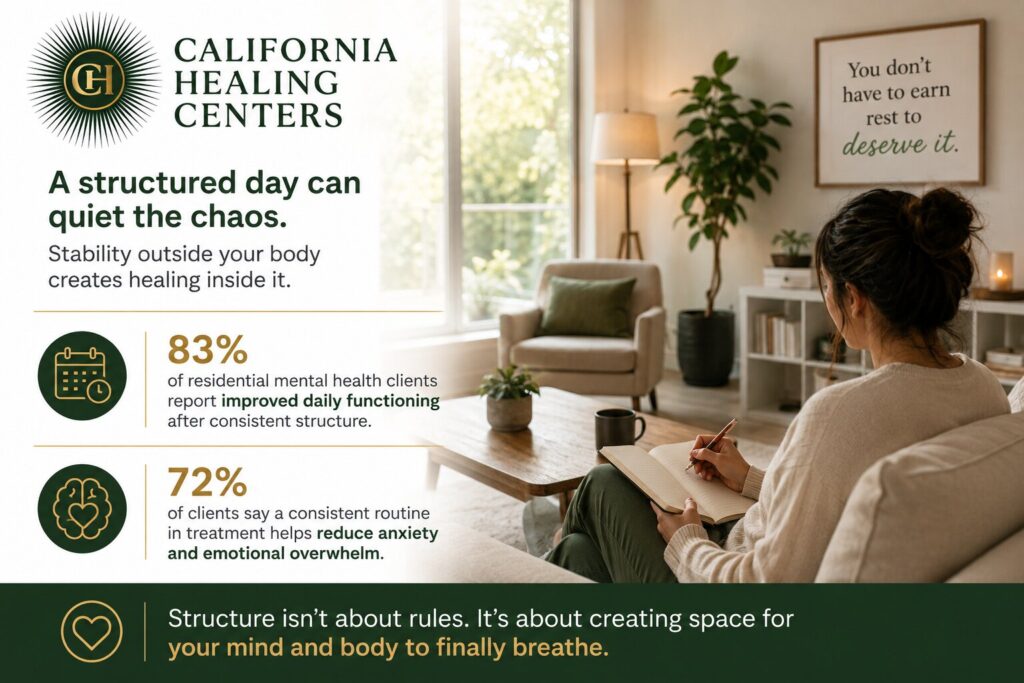
Structure Isn’t Punishment — It’s Relief
This is probably the biggest misconception about treatment schedules.
People imagine rules, restrictions, and loss of freedom.
What many actually experience is relief from constant decision fatigue and hypervigilance.
When someone has spent years managing anxiety, depression, trauma, substance use, or burnout while still maintaining responsibilities, their brain becomes overloaded from nonstop pressure.
Structure temporarily carries some of that weight.
You don’t have to plan every second.
You don’t have to keep pretending you’re fine.
You don’t have to manage everyone else’s expectations while quietly drowning yourself.
That’s why many people searching for what to expect residential mental health care are actually looking for permission.
Permission to stop surviving at full speed.
Permission to rest without earning it first.
Permission to admit that functioning and healing are not always the same thing.
Treatment Doesn’t Erase Your Ambition
This fear comes up constantly.
People worry they’ll lose their edge if they slow down. They fear becoming less driven, less sharp, less productive.
But exhaustion is not personality.
Hypervigilance is not ambition.
And constant stress is not strength.
Good treatment doesn’t flatten people. It helps separate who they are from the survival strategies they’ve mistaken for identity.
Many clients leave treatment realizing they’re still motivated. Still intelligent. Still capable.
Just less consumed.
Less frantic.
Less emotionally underwater.
And for the first time in a long time, they’re functioning without feeling like they’re being chased internally all day.
FAQ: What Daily Life Is Really Like in Residential Mental Health Treatment
What time does the day usually start in residential treatment?
Most programs begin mornings around 7–8 a.m. with breakfast, medication support if needed, and morning routines like check-ins, mindfulness, or journaling.
Is every hour of the day scheduled?
Not completely. Structured treatment includes therapy sessions and activities throughout the day, but there is also downtime built in for rest, reflection, meals, and personal space.
Can I still use my phone or laptop?
Policies vary by program. Some centers allow limited phone or laptop access during designated times, while others encourage reduced screen time to help clients focus on recovery and emotional regulation.
Do people work while in treatment?
Some high-functioning clients maintain limited work responsibilities if clinically appropriate, but many benefit from stepping away from work temporarily to fully focus on stabilization and healing.
Is treatment emotionally intense all day long?
Not usually. Good programs balance emotional work with nervous system regulation, recreation, practical coping skills, and downtime to avoid emotional overload.
What if I hate slowing down?
That’s extremely common. Many high-functioning people initially feel restless, anxious, or guilty during downtime because their nervous systems are conditioned to constant stimulation and productivity.
Will treatment feel like a hospital?
Most residential mental health centers feel far more human and relational than people expect. While there is structure and clinical support, quality programs aim to create safety, connection, and stability rather than punishment.
What do people do during free time?
Free time may include resting, journaling, reading, connecting with peers, exercising, attending recreational activities, or simply sitting quietly without constant pressure or stimulation.
Is residential treatment only for people in crisis?
No. Many people entering live-in care are still functioning outwardly while internally struggling with anxiety, burnout, depression, trauma, or substance use that has become unsustainable.
How do I know if I need this level of care?
People often consider residential treatment when daily functioning becomes emotionally exhausting, outpatient therapy hasn’t been enough, or they feel unable to slow down without falling apart.
If you’re exhausted from carrying everything alone and want a clearer understanding of what healing inside a structured environment can actually feel like, California Healing Centers offers compassionate residential treatment program services designed for people who are tired of surviving on adrenaline alone.
Call (858) 330-4769 or visit our residential treatment program services to learn more about our residential treatment program services in San Diego, CA.