
Could There Be More Behind These Explosive Reactions?

A parent recently called us about their twenty-two-year-old son.

The conversation started with confusion.

Then fear.

Then heartbreak.

“One minute he’s completely fine,” the parent said. “We’re talking normally. Everything feels okay. Then suddenly he’s yelling, saying awful things, storming out, and slamming doors. An hour later he’s apologizing and telling us he hates himself.”

The parent paused.

Then asked the question many families eventually ask:

“What is happening to him?”

If you’re reading this because you recognize yourself—or someone you love—in that story, you are not alone.

Many people live with emotional reactions that seem to arrive out of nowhere. One moment they feel calm. The next moment they’re overwhelmed by anger, hurt, panic, or emotional pain they cannot seem to control.

Afterward comes the guilt.

The regret.

The shame.

The promise that it will never happen again.

Then the cycle repeats.

If you’ve been searching for answers, learning more about emotional regulation support and skills may help you understand why these reactions happen and what options may exist for moving forward.

It Often Feels Like the Reaction Happens Too Fast to Stop

One of the most frustrating parts of emotional outbursts is how quickly they can happen.

People often tell us:

“I knew I was upset, but I didn’t realize how upset until it was too late.”

That’s because emotional escalation doesn’t always feel gradual.

Sometimes it feels like flipping a light switch.

You’re calm.

Then you’re hurt.

Then defensive.

Then furious.

By the time you realize what’s happening, words are already coming out.

The argument is already underway.

The damage is already being done.

Many people assume this means they have no control.

That assumption is understandable.

But it isn’t necessarily true.

Often, there are warning signs.

The challenge is that people haven’t learned how to recognize them yet.

Most Emotional Explosions Start Long Before the Argument

Families often focus on the event that triggered the outburst.

The text message.

The disagreement.

The criticism.

The misunderstanding.

Those moments matter.

But they are rarely the entire story.

Think of emotional overwhelm like a cup slowly filling with water.

Stress adds a little.

Poor sleep adds more.

Relationship tension adds more.

Work pressure adds more.

Anxiety adds more.

Unresolved pain adds more.

Eventually, the cup becomes completely full.

At that point, even one additional drop can cause overflow.

The final trigger gets blamed because it’s visible.

The months of accumulated emotional pressure often go unnoticed.

That’s why people frequently look back and think:

“I can’t believe I reacted that strongly.”

The reaction wasn’t only about the trigger.

It was about everything that came before it.

The Words You Say During These Moments May Not Reflect What You Truly Feel

One reason these experiences are so painful is that many people genuinely love the individuals they hurt.

Parents hurt children.

Children hurt parents.

Partners hurt each other.

Friends damage relationships.

Then, once emotions settle, they are horrified by what happened.

People often tell us:

“I didn’t mean those things.”

“I don’t even know why I said that.”

“That’s not who I am.”

Those statements are important.

Because they highlight a key reality.

The person underneath the reaction often feels very different from the person who emerged during the outburst.

That disconnect is one reason shame becomes so intense afterward.

People aren’t just upset about the argument.

They’re questioning their own character.

The Shame Can Become Its Own Crisis

Many families focus on the anger because it’s loud.

The shame is quieter.

But it can be equally damaging.

After an emotional explosion, many people become their own harshest critic.

They replay conversations repeatedly.

Analyze every word.

Imagine what other people think of them.

Tell themselves they’re broken.

Tell themselves they’re impossible to love.

Tell themselves they’re beyond help.

Over time, the self-criticism becomes another source of emotional pain.

And emotional pain often increases emotional sensitivity.

Which increases the likelihood of future reactions.

This is one reason the cycle becomes so difficult to break.

The anger creates shame.

The shame creates pain.

The pain creates vulnerability.

The vulnerability increases future anger.

The pattern feeds itself.

Intense Emotions Are Not the Same Thing as Being a Bad Person

This is one of the most important things we want people to understand.

Struggling with emotional regulation does not automatically make someone cruel.

It does not automatically make someone manipulative.

And it does not automatically mean someone lacks self-control.

Many people experiencing these struggles desperately wish they could respond differently.

If simply wanting to change were enough, they would have changed long ago.

The reality is that emotional regulation is a skill.

Just like communication.

Just like conflict resolution.

Just like stress management.

Some people develop those skills naturally through life experiences.

Others need more structured support.

Needing support is not a personal failure.

It’s part of being human.

Sometimes There Is More Happening Beneath the Surface

When families are in crisis, it’s easy to focus exclusively on visible behavior.

The yelling.

The arguments.

The impulsive reactions.

But emotional outbursts often exist alongside other challenges.

Depression.

Anxiety.

Trauma.

Chronic stress.

Low self-esteem.

Fear of abandonment.

Substance use.

Difficulty trusting others.

Overwhelming loneliness.

Many young adults who appear angry are actually hurting.

The anger is simply easier to see.

Parents often tell us they didn’t realize how much pain their child was carrying until much later.

The emotional reactions were never the entire problem.

They were symptoms of something deeper.

That’s why understanding the whole picture matters.
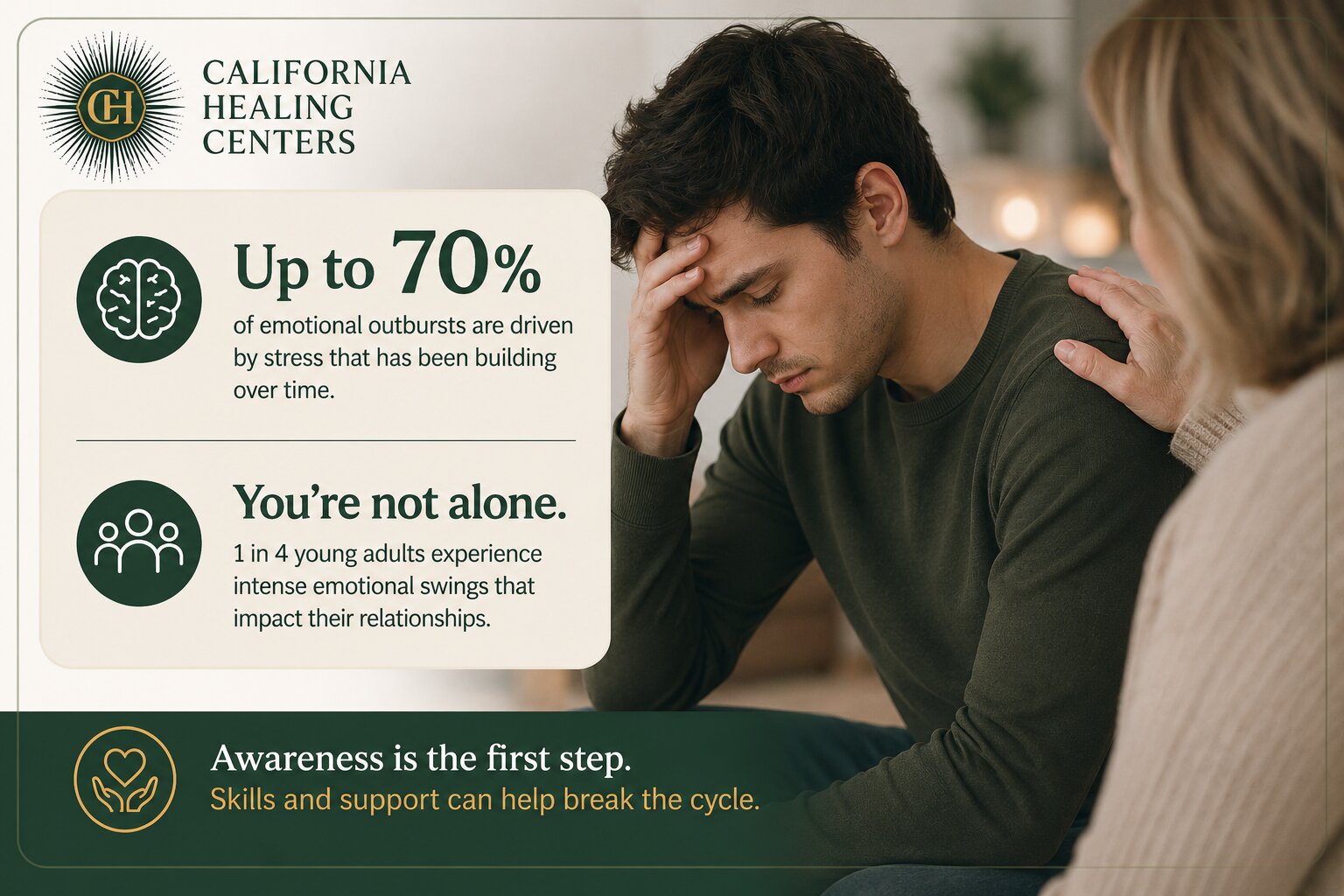
Could There Be More Behind These Explosive Reactions

Why Loved Ones Often Feel Like They’re Walking on Eggshells

Families affected by emotional instability often develop a similar pattern.

Everyone becomes cautious.

Conversations become strategic.

People avoid difficult topics.

Parents monitor tone of voice.

Siblings stay quiet.

Partners second-guess every word.

Eventually, family members feel like they’re walking through a room filled with broken glass.

Always watching their step.

Always preparing for the next explosion.

Unfortunately, this often creates even more tension.

The person struggling emotionally notices the distance.

They feel judged.

Misunderstood.

Rejected.

Which can intensify emotional reactions even further.

This is why healing often involves more than helping one person.

Relationships frequently need support too.

Learning Emotional Regulation Is Like Building a Muscle

People sometimes hope there will be a quick fix.

A single insight.

A magic phrase.

A dramatic breakthrough.

Those moments can happen.

But most emotional growth happens differently.

It happens through repetition.

Practice.

Awareness.

Learning new skills.

At first, someone may only recognize emotional escalation after an argument.

Later, they notice it during the argument.

Eventually, they recognize it before the argument begins.

That progression matters.

Because awareness creates choice.

And choice creates change.

One patient described the experience beautifully.

“For years, my emotions felt like a tidal wave. Now they still show up, but I can see them coming.”

That’s often what progress looks like.

Not the absence of emotion.

Better navigation of emotion.

Support Can Help You Understand the Pattern

Many people spend years trying to solve these struggles through willpower alone.

They promise themselves they’ll stay calmer.

Be more patient.

Think before speaking.

Try harder.

Then they become discouraged when those promises aren’t enough.

The reason is simple.

Willpower alone rarely solves emotional patterns that have been developing for years.

Support can help people understand what’s driving their reactions.

Some individuals find that support through IFS therapy helps them explore emotional wounds and protective patterns that influence present-day behavior.

Others benefit from care in group settings, where they learn practical skills while discovering they are far from alone.

Many people are surprised by how much relief comes from finally understanding why these reactions happen.

Understanding often becomes the beginning of change.

There Is Hope Beyond Anger and Regret

If you’ve spent years cycling between calm, rage, guilt, and self-hatred, it may feel impossible to imagine a different future.

Many people feel that way before receiving support.

The good news is that emotional patterns are not permanent life sentences.

People learn new skills.

Build new habits.

Develop greater awareness.

Strengthen relationships.

Repair trust.

And begin responding differently to situations that once felt overwhelming.

Many individuals searching for information about rapid mood swings adult experiences are not looking for a label. They’re looking for hope. They’re trying to understand why they keep hurting people they love and why they feel so terrible afterward.

The answer is often more complex—and more hopeful—than they expect.

These reactions can be understood.

And when they are understood, meaningful change becomes possible.

If emotional reactions are affecting your relationships, family life, or overall well-being, support is available. Call 858-330-4769 or visit our mental health therapy and DBT services to learn more about our mental health therapy and DBT services San Diego, CA.

Frequently Asked Questions

Why do my emotions change so quickly?

Rapid emotional changes can be influenced by stress, anxiety, depression, trauma, emotional overwhelm, sleep disruption, and difficulties with emotional regulation.

Why do I say hurtful things when I’m angry?

During intense emotional moments, the brain often shifts into a reactive state. This can make it harder to pause, think clearly, and communicate effectively.

Why do I feel guilty after emotional outbursts?

Many people experience shame and regret because their reactions don’t reflect how they truly want to treat others.

Are emotional outbursts a sign of a mental health condition?

Not necessarily. While emotional outbursts can occur alongside mental health challenges, they can also be influenced by stress, coping patterns, past experiences, and emotional regulation difficulties.

Can therapy help with intense anger?

Yes. Many therapeutic approaches help individuals better understand emotional triggers, improve communication skills, and develop healthier coping strategies.

Why do small situations trigger big reactions?

The visible trigger is often only part of the picture. Unresolved emotional stress and accumulated pressure can make small events feel much larger than they appear.

How can parents support a young adult experiencing emotional instability?

Parents can help by remaining calm, encouraging professional support, listening without judgment, and maintaining healthy boundaries during difficult situations.

Can relationships recover after repeated emotional outbursts?

In many cases, yes. With accountability, skill development, improved communication, and appropriate support, relationships can often heal and grow stronger over time.

When should someone seek professional help?

If emotional reactions are causing significant distress, damaging relationships, interfering with daily life, or leading to feelings of hopelessness, professional support may be beneficial.

Accessibility Toolbar

Could There Be More Behind These Explosive Reactions?

A parent recently called us about their twenty-two-year-old son.

The conversation started with confusion.

Then fear.

Then heartbreak.

"One minute he's completely fine," the parent said. "We're talking normally. Everything feels okay. Then suddenly he's yelling, saying awful things, storming out, and slamming doors. An hour later he's apologizing and telling us he hates himself."

The parent paused.

Then asked the question many families eventually ask:

"What is happening to him?"

If you're reading this because you recognize yourself—or someone you love—in that story, you are not alone.

Many people live with emotional reactions that seem to arrive out of nowhere. One moment they feel calm. The next moment they're overwhelmed by anger, hurt, panic, or emotional pain they cannot seem to control.

Afterward comes the guilt.

The regret.

The shame.

The promise that it will never happen again.

Then the cycle repeats.

If you've been searching for answers, learning more about emotional regulation support and skills may help you understand why these reactions happen and what options may exist for moving forward.

It Often Feels Like the Reaction Happens Too Fast to Stop

One of the most frustrating parts of emotional outbursts is how quickly they can happen.

People often tell us:

"I knew I was upset, but I didn't realize how upset until it was too late."

That's because emotional escalation doesn't always feel gradual.

Sometimes it feels like flipping a light switch.

You're calm.

Then you're hurt.

Then defensive.

Then furious.

By the time you realize what's happening, words are already coming out.

The argument is already underway.

The damage is already being done.

Many people assume this means they have no control.

That assumption is understandable.

But it isn't necessarily true.

Often, there are warning signs.

The challenge is that people haven't learned how to recognize them yet.

Most Emotional Explosions Start Long Before the Argument

Families often focus on the event that triggered the outburst.

The text message.

The disagreement.

The criticism.

The misunderstanding.

Those moments matter.

But they are rarely the entire story.

Think of emotional overwhelm like a cup slowly filling with water.

Stress adds a little.

Poor sleep adds more.

Relationship tension adds more.

Work pressure adds more.

Anxiety adds more.

Unresolved pain adds more.

Eventually, the cup becomes completely full.

At that point, even one additional drop can cause overflow.

The final trigger gets blamed because it's visible.

The months of accumulated emotional pressure often go unnoticed.

That's why people frequently look back and think:

"I can't believe I reacted that strongly."

The reaction wasn't only about the trigger.

It was about everything that came before it.

The Words You Say During These Moments May Not Reflect What You Truly Feel

One reason these experiences are so painful is that many people genuinely love the individuals they hurt.

Parents hurt children.

Children hurt parents.

Partners hurt each other.

Friends damage relationships.

Then, once emotions settle, they are horrified by what happened.

People often tell us:

"I didn't mean those things."

"I don't even know why I said that."

"That's not who I am."

Those statements are important.

Because they highlight a key reality.

The person underneath the reaction often feels very different from the person who emerged during the outburst.

That disconnect is one reason shame becomes so intense afterward.

People aren't just upset about the argument.

They're questioning their own character.

The Shame Can Become Its Own Crisis

Many families focus on the anger because it's loud.

The shame is quieter.

But it can be equally damaging.

After an emotional explosion, many people become their own harshest critic.

They replay conversations repeatedly.

Analyze every word.

Imagine what other people think of them.

Tell themselves they're broken.

Tell themselves they're impossible to love.

Tell themselves they're beyond help.

Over time, the self-criticism becomes another source of emotional pain.

And emotional pain often increases emotional sensitivity.

Which increases the likelihood of future reactions.

This is one reason the cycle becomes so difficult to break.

The anger creates shame.

The shame creates pain.

The pain creates vulnerability.

The vulnerability increases future anger.

The pattern feeds itself.

Intense Emotions Are Not the Same Thing as Being a Bad Person

This is one of the most important things we want people to understand.

Struggling with emotional regulation does not automatically make someone cruel.

It does not automatically make someone manipulative.

And it does not automatically mean someone lacks self-control.

Many people experiencing these struggles desperately wish they could respond differently.

If simply wanting to change were enough, they would have changed long ago.

The reality is that emotional regulation is a skill.

Just like communication.

Just like conflict resolution.

Just like stress management.

Some people develop those skills naturally through life experiences.

Others need more structured support.

Needing support is not a personal failure.

It's part of being human.

Sometimes There Is More Happening Beneath the Surface

When families are in crisis, it's easy to focus exclusively on visible behavior.

The yelling.

The arguments.

The impulsive reactions.

But emotional outbursts often exist alongside other challenges.

Depression.

Anxiety.

Trauma.

Chronic stress.

Low self-esteem.

Fear of abandonment.

Substance use.

Difficulty trusting others.

Overwhelming loneliness.

Many young adults who appear angry are actually hurting.

The anger is simply easier to see.

Parents often tell us they didn't realize how much pain their child was carrying until much later.

The emotional reactions were never the entire problem.

They were symptoms of something deeper.

That's why understanding the whole picture matters.

Could There Be More Behind These Explosive Reactions

Why Loved Ones Often Feel Like They're Walking on Eggshells

Families affected by emotional instability often develop a similar pattern.

Everyone becomes cautious.

Conversations become strategic.

People avoid difficult topics.

Parents monitor tone of voice.

Siblings stay quiet.

Partners second-guess every word.

Eventually, family members feel like they're walking through a room filled with broken glass.

Always watching their step.

Always preparing for the next explosion.

Unfortunately, this often creates even more tension.

The person struggling emotionally notices the distance.

They feel judged.

Misunderstood.

Rejected.

Which can intensify emotional reactions even further.

This is why healing often involves more than helping one person.

Relationships frequently need support too.

Learning Emotional Regulation Is Like Building a Muscle

People sometimes hope there will be a quick fix.

A single insight.

A magic phrase.

A dramatic breakthrough.

Those moments can happen.

But most emotional growth happens differently.

It happens through repetition.

Practice.

Awareness.

Learning new skills.

At first, someone may only recognize emotional escalation after an argument.

Later, they notice it during the argument.

Eventually, they recognize it before the argument begins.

That progression matters.

Because awareness creates choice.

And choice creates change.

One patient described the experience beautifully.

"For years, my emotions felt like a tidal wave. Now they still show up, but I can see them coming."

That's often what progress looks like.

Not the absence of emotion.

Better navigation of emotion.

Support Can Help You Understand the Pattern

Many people spend years trying to solve these struggles through willpower alone.

They promise themselves they'll stay calmer.

Be more patient.

Think before speaking.

Try harder.

Then they become discouraged when those promises aren't enough.

The reason is simple.

Willpower alone rarely solves emotional patterns that have been developing for years.

Support can help people understand what's driving their reactions.

Some individuals find that support through IFS therapy helps them explore emotional wounds and protective patterns that influence present-day behavior.

Others benefit from care in group settings, where they learn practical skills while discovering they are far from alone.

Many people are surprised by how much relief comes from finally understanding why these reactions happen.

Understanding often becomes the beginning of change.

There Is Hope Beyond Anger and Regret

If you've spent years cycling between calm, rage, guilt, and self-hatred, it may feel impossible to imagine a different future.

Many people feel that way before receiving support.

The good news is that emotional patterns are not permanent life sentences.

People learn new skills.

Build new habits.

Develop greater awareness.

Strengthen relationships.

Repair trust.

And begin responding differently to situations that once felt overwhelming.

Many individuals searching for information about rapid mood swings adult experiences are not looking for a label. They're looking for hope. They're trying to understand why they keep hurting people they love and why they feel so terrible afterward.

The answer is often more complex—and more hopeful—than they expect.

These reactions can be understood.

And when they are understood, meaningful change becomes possible.

If emotional reactions are affecting your relationships, family life, or overall well-being, support is available. Call 858-330-4769 or visit our mental health therapy and DBT services to learn more about our mental health therapy and DBT services San Diego, CA.

Frequently Asked Questions

Why do my emotions change so quickly?

Rapid emotional changes can be influenced by stress, anxiety, depression, trauma, emotional overwhelm, sleep disruption, and difficulties with emotional regulation.

Why do I say hurtful things when I'm angry?

During intense emotional moments, the brain often shifts into a reactive state. This can make it harder to pause, think clearly, and communicate effectively.

Why do I feel guilty after emotional outbursts?

Many people experience shame and regret because their reactions don't reflect how they truly want to treat others.

Are emotional outbursts a sign of a mental health condition?

Not necessarily. While emotional outbursts can occur alongside mental health challenges, they can also be influenced by stress, coping patterns, past experiences, and emotional regulation difficulties.

Can therapy help with intense anger?

Yes. Many therapeutic approaches help individuals better understand emotional triggers, improve communication skills, and develop healthier coping strategies.

Why do small situations trigger big reactions?

The visible trigger is often only part of the picture. Unresolved emotional stress and accumulated pressure can make small events feel much larger than they appear.

How can parents support a young adult experiencing emotional instability?

Parents can help by remaining calm, encouraging professional support, listening without judgment, and maintaining healthy boundaries during difficult situations.

Can relationships recover after repeated emotional outbursts?

In many cases, yes. With accountability, skill development, improved communication, and appropriate support, relationships can often heal and grow stronger over time.

When should someone seek professional help?

If emotional reactions are causing significant distress, damaging relationships, interfering with daily life, or leading to feelings of hopelessness, professional support may be beneficial.

Table of Contents
Scroll to Top