
From the outside, nothing looks unusual.
There are no visible rituals. No repeated handwashing. No checking the locks dozens of times.
Instead, the struggle happens almost entirely inside your mind.
You replay conversations over and over. You question whether an intrusive thought means something about your character. You silently reassure yourself that you’re a good person, only to feel the doubt return minutes later.
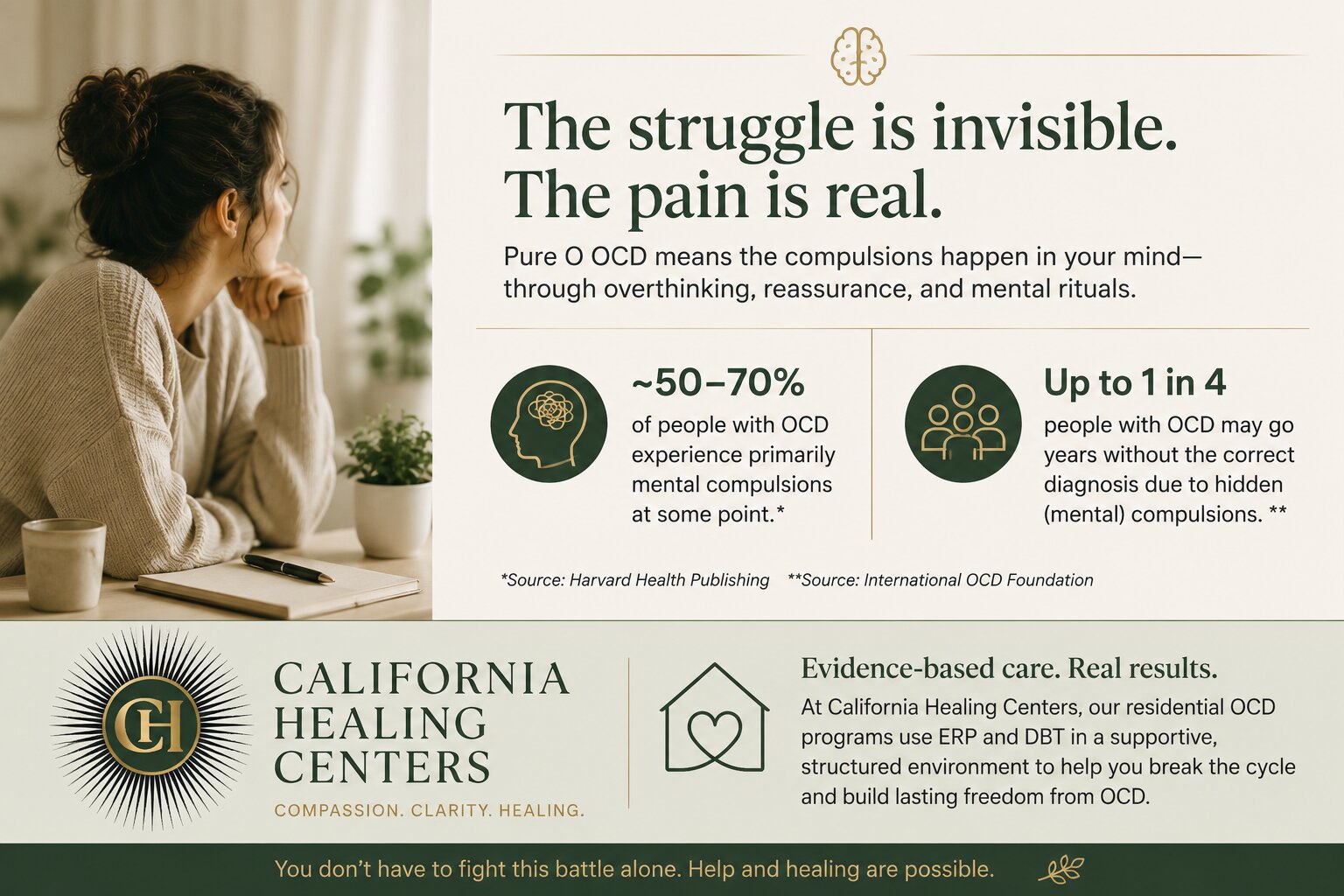
If you’ve been searching for Pure O OCD, you may have spent years believing you had anxiety, depression, or simply an overactive mind. Many people don’t realize they’re experiencing obsessive-compulsive disorder because the compulsions aren’t outwardly visible—they’re mental.
One of the biggest misconceptions about Pure O is that it involves obsessions without compulsions. In reality, the compulsions are still there. They simply occur internally through repetitive thinking, reassurance, checking, reviewing, and avoidance.
For individuals whose intrusive thoughts and mental rituals have begun interfering with daily life, evidence-based OCD treatment can help break the cycle. At California Healing Centers in Rancho Santa Fe, treatment includes Exposure and Response Prevention (ERP), Cognitive Behavioral Therapy (CBT), and comprehensive residential care for adults with complex OCD symptoms.
What Pure O OCD Is
Pure O OCD is an informal term used to describe obsessive-compulsive disorder in which compulsions are primarily mental rather than easily observable.
Despite the name, Pure O is not considered OCD without compulsions.
Instead, the compulsions happen internally.
Like all forms of OCD, the cycle begins with unwanted intrusive thoughts, images, or doubts that create significant anxiety.
To reduce that anxiety, the brain performs compulsions.
In more recognizable forms of OCD, these compulsions may include behaviors such as checking doors or washing hands.
In Pure O, they often involve repetitive mental processes instead.
These internal compulsions can be just as exhausting and time-consuming as visible rituals.
Common Obsession Themes
Although intrusive thoughts vary from person to person, certain themes are especially common.
Harm
Fear of accidentally or intentionally harming someone despite having no desire to do so.
Examples include:
- “What if I lose control?”
- “What if I’m secretly dangerous?”
Sexual intrusive thoughts
Unwanted sexual thoughts that conflict with the person’s values or identity.
These thoughts are deeply distressing and should not be confused with genuine desires or intentions.
Religious or scrupulosity OCD
Persistent fears about morality, sin, offending God, or failing to live according to one’s beliefs.
Individuals may constantly question whether they have done something spiritually wrong.
Relationship OCD (ROCD)
Obsessions centered on romantic relationships, including:
- “Do I really love my partner?”
- “What if I’m making the wrong decision?”
- “What if my relationship isn’t perfect?”
The distress comes from uncertainty rather than the relationship itself.
Existential OCD
Obsessive questioning about reality, consciousness, free will, or the meaning of life that becomes repetitive and anxiety-driven rather than philosophical curiosity.
Why Pure O Is Mistaken for Anxiety or Depression
Because compulsions are hidden, Pure O often goes unrecognized for years.
People commonly describe symptoms such as:
- Constant overthinking
- Persistent self-doubt
- Rumination
- Anxiety
- Guilt
- Shame
- Difficulty concentrating
Without understanding the OCD cycle, both individuals and healthcare providers may interpret these symptoms as generalized anxiety, depression, or perfectionism alone.
While anxiety and depression frequently occur alongside OCD, the defining feature of OCD is the ongoing cycle of:
- Intrusive thoughts
- Anxiety
- Compulsions
- Temporary relief
- Return of the intrusive thought
Recognizing the mental compulsions is often what leads to an accurate diagnosis.
The Mental Compulsions People Do Not Recognize as Compulsions
Many people assume compulsions must involve physical behaviors.
In reality, compulsions can occur entirely within the mind.
Common mental compulsions include:
Mental reviewing
Replaying memories repeatedly to determine whether something happened “correctly.”
Reassurance
Silently telling yourself:
- “I’m a good person.”
- “I would never do that.”
- “Everything is okay.”
Thought checking
Monitoring thoughts to determine whether they feel voluntary or unwanted.
Analyzing
Trying to think your way to complete certainty.
Comparing
Constantly comparing present thoughts or feelings to previous experiences.
Neutralizing
Replacing an intrusive thought with a “good” thought in hopes of canceling it out.
Avoidance
Avoiding people, places, conversations, or situations that might trigger intrusive thoughts.
Although these strategies temporarily reduce anxiety, they strengthen OCD over time by reinforcing the belief that intrusive thoughts require immediate action or certainty.
Why Mental Compulsions Keep OCD Going
One of the most frustrating aspects of Pure O is that mental compulsions often feel like problem-solving.
Someone might believe:
- “If I think about this long enough, I’ll finally know the truth.”
- “If I can become 100% certain, I’ll stop worrying.”
- “If I review the memory one more time, I’ll feel better.”
Unfortunately, certainty is exactly what OCD promises but never delivers.
Each attempt to resolve doubt provides only temporary relief before another intrusive thought appears.
Over time, the cycle becomes increasingly automatic.
The goal of treatment is not to eliminate uncertainty from life.
It is to reduce the need to respond to every intrusive thought with a mental ritual.
How ERP (Exposure and Response Prevention) Treats Pure O
Exposure and Response Prevention (ERP) is considered the gold standard behavioral treatment for OCD.
Unlike therapies that focus on proving intrusive thoughts are irrational, ERP helps individuals change how they respond to uncertainty.
Exposure
With guidance from a trained therapist, clients gradually face situations, thoughts, or triggers that normally produce obsessive anxiety.
These exposures are carefully planned and individualized.
Response prevention
Instead of performing mental compulsions such as reviewing, reassuring, analyzing, or checking, clients practice allowing uncertainty to exist without responding to it.
Over time, the brain learns an important lesson:
Intrusive thoughts are uncomfortable, but they are not dangerous and do not require compulsive responses.
Many treatment plans also incorporate:
- Cognitive Behavioral Therapy (CBT)
- Mindfulness-based strategies
- Acceptance techniques
- Medication management when appropriate
The combination helps reduce the power OCD holds over daily life rather than attempting to eliminate intrusive thoughts altogether.
What Residential OCD Treatment Looks Like
For some people, weekly outpatient therapy provides effective support.
Others find that intrusive thoughts and mental compulsions dominate so much of the day that more intensive treatment becomes appropriate.
California Healing Centers offers residential treatment for adults with OCD and related mental health conditions.
Treatment begins with a comprehensive assessment and an individualized care plan that may include:
- Exposure and Response Prevention (ERP)
- Cognitive Behavioral Therapy (CBT)
- Individual psychotherapy
- Group therapy
- Medication evaluation and management when appropriate
- Mindfulness-based interventions
- Family involvement when clinically appropriate
- Relapse prevention planning
Located in Rancho Santa Fe in San Diego County, California Healing Centers provides a structured residential environment where clients can practice ERP every day rather than only during weekly therapy sessions. This level of immersion allows clinicians to observe patterns in real time, guide exposure work throughout the day, and help clients build new responses to intrusive thoughts in a consistent therapeutic setting.
Recovery Is About Changing Your Relationship with Uncertainty
People living with Pure O often spend years believing they simply think too much.
In reality, they are frequently caught in an OCD cycle driven by intrusive thoughts and hidden compulsions.
The good news is that recovery does not require achieving perfect certainty or eliminating every unwanted thought.
It involves learning that intrusive thoughts do not define you—and that you no longer have to answer every doubt your brain presents.
With evidence-based treatment, many people find that the thoughts become less distressing, the urge to perform mental compulsions decreases, and daily life gradually becomes guided by values rather than fear.
Frequently Asked Questions
What is Pure O OCD?
Pure O OCD is an informal term for obsessive-compulsive disorder in which compulsions are primarily mental rather than visible. Individuals experience intrusive thoughts followed by internal compulsions such as reassurance, reviewing memories, analyzing, or mentally checking, even though outward rituals may be minimal.
Is Pure O real OCD?
Yes. Although “Pure O” is not an official diagnostic category, it describes a well-recognized presentation of OCD. The misconception is that there are no compulsions; in reality, the compulsions occur internally rather than through observable behaviors.
How is Pure O different from regular OCD?
The underlying OCD cycle is the same. The primary difference is that compulsions are hidden. Instead of washing, checking, or arranging objects, people with Pure O often perform mental rituals such as reassurance, rumination, reviewing, or avoidance to reduce anxiety.
Can Pure O be treated?
Yes. Pure O responds well to evidence-based treatments, particularly Exposure and Response Prevention (ERP) and Cognitive Behavioral Therapy (CBT). Many people also benefit from mindfulness-based strategies and medication when clinically appropriate.