
Relationship OCD (ROCD): Signs, Symptoms, and How to Get Help

You love your partner or at least you think you do. But lately, your mind won’t stop questioning everything. Are you really attracted to them? Are they “the one”? What if you’re making a terrible mistake? And no matter how many times you reassure yourself, the doubt comes back.

If those thoughts feel like they’re on a loop you can’t turn off and if the doubt persists even when everything in the relationship is objectively fine, you may be dealing with relationship OCD.

ROCD isn’t a sign that something is wrong with your relationship. It’s a sign that OCD has latched onto your relationship as its focus. Here’s what it is, how to recognize it, and why Internal Family Systems therapy actually helps.

What Is Relationship OCD (ROCD)?

Relationship OCD is a subtype of OCD in which obsessions center on romantic relationships. Like all OCD, it involves intrusive, unwanted thoughts that generate significant distress, and compulsions behaviors or mental rituals performed to relieve that distress temporarily.

The key feature of ROCD is ego-dystonic doubt: the doubts feel wrong and alien, not like genuine reflection on the relationship. People with ROCD aren’t ambivalent about their partner in the normal sense, they’re trapped in a cycle of forced questioning that they desperately want to stop.

ROCD appears in two overlapping forms:

  • Partner-focused ROCD: Obsessive doubts about the partner, their appearance, intelligence, personality, suitability
  • Relationship-focused ROCD: Obsessive doubts about the relationship itself or one’s own feelings, “Do I really love them?” “Is this the right relationship?”

Research suggests that relationship-themed obsessions appear in approximately 25% of people with OCD, making ROCD one of the more common OCD subtypes.

ROCD vs. Genuine Relationship Doubt — How to Tell the Difference

This is the question people with ROCD most frequently search for, and it’s worth answering directly.

Normal relationship doubt is contextual, resolves with reflection or conversation, and doesn’t consume a significant portion of your mental bandwidth. It tends to arise when something concrete happens, a conflict, a life-stage transition, incompatibility around something real.

ROCD doubt is different in quality:

  • It is intrusive — it arrives uninvited and feels impossible to dismiss
  • It is repetitive — the same doubt recycles regardless of what evidence you gather
  • It causes marked distress disproportionate to the actual state of the relationship
  • It is ego-dystonic — it feels wrong and foreign, not like a genuine internal voice
  • Reassurance provides only temporary relief — the doubt always returns, often more urgently

That last point is perhaps the clearest diagnostic signal. In normal doubt, reflection and reassurance actually resolve the question. In ROCD, reassurance feeds the cycle, it produces brief relief and then the question returns, requiring more reassurance. OCD always moves the goalposts.

Signs and Symptoms of Relationship OCD

Partner-Focused Obsessions

  • Constantly questioning whether your partner is attractive enough, smart enough, or “good enough”
  • Intrusive thoughts about an ex-partner or another person
  • Mentally comparing your partner to others and feeling compelled to resolve the comparison
  • Noticing flaws in your partner and being unable to stop cataloguing them
  • Seeking reassurance from friends or family about the partner’s qualities

Relationship-Focused Obsessions

  • “Do I really love them?” repeating on a loop with no resolution
  • Intense fear that you’re in the wrong relationship and ruining your life
  • Checking your own emotional or physical response to your partner for “proof” of love or attraction
  • Avoiding physical affection because it triggers doubt about whether the feelings are real
  • Fear of commitment milestones (moving in together, engagement) because they feel permanently “locking in” the wrong choice

Common Compulsions in ROCD

In ROCD, many compulsions are mental rather than physical — which makes them harder to identify but no less real:

  • Seeking reassurance from your partner (“Do you think I love you enough?”), friends, or therapists
  • Mentally reviewing past moments in the relationship to find evidence of genuine love
  • Googling “how do you know if you’re in the right relationship” or “ROCD symptoms” repeatedly (yes, this counts as a compulsion — it’s reassurance-seeking)
  • Confessing doubts compulsively to your partner
  • Breaking up with and returning to a partner in search of certainty that never arrives
  • Comparing the relationship to idealized standards or other couples
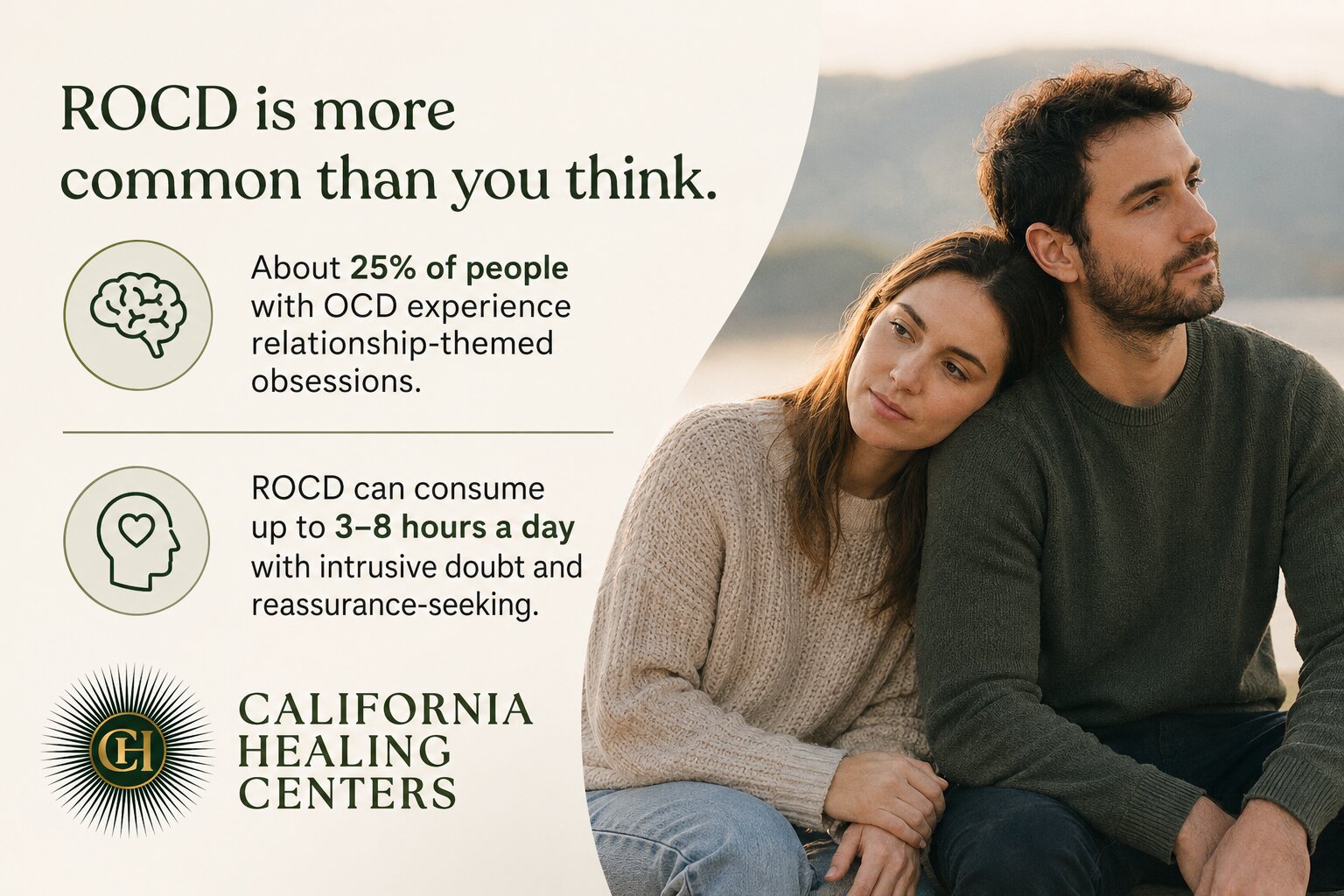
How to Recognize Relationship OCD and Find Support

What Triggers Relationship OCD?

ROCD symptoms often intensify around:

  • Relationship milestones: moving in together, engagement, having children — anything that raises the stakes of the “what if I’m wrong” fear
  • Stress and sleep deprivation: both raise general anxiety, which amplifies OCD
  • Exposure to attractive people or ex-partners: can trigger partner-focused doubt spirals
  • Relationship conflict: even minor disagreements can trigger “maybe this is a sign” obsessing
  • Attachment trauma: a history of abandonment, betrayal, or relational trauma often underlies the intensity of ROCD — the fear is not just about the current relationship but about what losing it would mean

How Is ROCD Diagnosed?

There is no separate diagnostic code for ROCD in the DSM-5 — it falls under OCD (300.3). Diagnosis is based on the presence of obsessions and compulsions that cause marked distress or functional impairment, lasting more than one hour per day.

The challenge is that ROCD is frequently misdiagnosed as:

  • Relationship anxiety
  • Attachment disorder (anxious or fearful-avoidant)
  • Genuine incompatibility or ambivalence

These distinctions matter enormously — because the treatment for ROCD is fundamentally different from the treatment for relationship anxiety or attachment issues. A clinician unfamiliar with OCD subtypes may inadvertently reinforce the OCD cycle by encouraging the person to “explore their doubts” or “make a pros and cons list” — which are exactly the kinds of compulsions that worsen ROCD.

Seek a clinician with specific training in OCD and ERP.

Treatment for Relationship OCD

Exposure and Response Prevention (ERP)

ERP is the gold standard for all OCD subtypes, including ROCD. The core principle: deliberately expose yourself to obsession-triggering content while resisting the compulsion to neutralize the anxiety through reassurance, checking, or avoidance. Over repeated exposures, the obsession loses its power because the anxiety habituates and the brain learns that uncertainty is tolerable.

For ROCD, this means practicing sitting with doubt — “maybe I don’t love them enough, and I can tolerate not knowing for certain” — without seeking reassurance. This is uncomfortable at first. With guidance and practice, it becomes possible.

Cognitive Behavioral Therapy (CBT)

CBT for ROCD helps identify and challenge the underlying cognitive distortions that fuel the obsessions — the belief that certainty is necessary before you can commit, that doubt means danger, or that a “perfect” relationship should feel nothing but positive. Cognitive Behavioral Therapy also works on defusion techniques: learning to observe thoughts as mental events rather than facts that demand action.

Internal Family Systems (IFS) Therapy

For ROCD rooted in attachment trauma or deep fears of intimacy and abandonment, Internal Family Systems therapy offers a particularly powerful complement to ERP. IFS works with the “parts” driving the obsession — often a protective part that learned early that closeness leads to pain, and is now trying to prevent hurt by finding reasons to escape the relationship. Understanding and healing those parts reduces the intensity of the ROCD at its source, rather than just managing its symptoms.

Can ROCD Go Away on Its Own?

Without treatment, ROCD symptoms typically persist and tend to worsen around relationship milestones or during periods of stress. The risk of untreated ROCD is real: unnecessary relationship dissolution (ending relationships that were actually healthy), erosion of self-trust, and the development of depression or generalized anxiety over time.

With evidence-based treatment, significant symptom reduction is achievable. Full remission is possible. The goal of treatment is not certainty — it is learning to live with uncertainty without being controlled by it.

When to Seek a Higher Level of Care

If ROCD is severe enough to impair daily functioning — consuming hours each day, damaging the relationship, co-occurring with depression or significant anxiety — a higher level of clinical support may be needed. Intensive or residential treatment allows for daily therapeutic contact, medication optimization, and the kind of deep, sustained work that weekly outpatient therapy can’t replicate.

Our OCD treatment program at California Healing Centers includes clinicians experienced in ROCD and OCD subtypes, with expertise in ERP, CBT, and IFS.

Your Relationship Deserves Clarity. So Do You.

ROCD is not a reflection of your relationship or your character. It’s OCD doing what OCD does: attaching to what matters most and making you doubt it relentlessly. That’s not your intuition speaking. That’s a treatable condition.

With the right treatment, you can learn to separate your voice from OCD’s voice — and build the kind of presence and trust in yourself that no amount of reassurance-seeking can provide.

At California Healing Centers, our residential program in San Diego provides the immersive, expert-led environment that serious OCD requires. Learn about our program or speak with our admissions team today.

Accessibility Toolbar

Relationship OCD (ROCD): Signs, Symptoms, and How to Get Help

You love your partner or at least you think you do. But lately, your mind won't stop questioning everything. Are you really attracted to them? Are they "the one"? What if you're making a terrible mistake? And no matter how many times you reassure yourself, the doubt comes back.

If those thoughts feel like they're on a loop you can't turn off and if the doubt persists even when everything in the relationship is objectively fine, you may be dealing with relationship OCD.

ROCD isn't a sign that something is wrong with your relationship. It's a sign that OCD has latched onto your relationship as its focus. Here's what it is, how to recognize it, and why Internal Family Systems therapy actually helps.

What Is Relationship OCD (ROCD)?

Relationship OCD is a subtype of OCD in which obsessions center on romantic relationships. Like all OCD, it involves intrusive, unwanted thoughts that generate significant distress, and compulsions behaviors or mental rituals performed to relieve that distress temporarily.

The key feature of ROCD is ego-dystonic doubt: the doubts feel wrong and alien, not like genuine reflection on the relationship. People with ROCD aren't ambivalent about their partner in the normal sense, they're trapped in a cycle of forced questioning that they desperately want to stop.

ROCD appears in two overlapping forms:

  • Partner-focused ROCD: Obsessive doubts about the partner, their appearance, intelligence, personality, suitability
  • Relationship-focused ROCD: Obsessive doubts about the relationship itself or one's own feelings, "Do I really love them?" "Is this the right relationship?"

Research suggests that relationship-themed obsessions appear in approximately 25% of people with OCD, making ROCD one of the more common OCD subtypes.

ROCD vs. Genuine Relationship Doubt — How to Tell the Difference

This is the question people with ROCD most frequently search for, and it's worth answering directly.

Normal relationship doubt is contextual, resolves with reflection or conversation, and doesn't consume a significant portion of your mental bandwidth. It tends to arise when something concrete happens, a conflict, a life-stage transition, incompatibility around something real.

ROCD doubt is different in quality:

  • It is intrusive — it arrives uninvited and feels impossible to dismiss
  • It is repetitive — the same doubt recycles regardless of what evidence you gather
  • It causes marked distress disproportionate to the actual state of the relationship
  • It is ego-dystonic — it feels wrong and foreign, not like a genuine internal voice
  • Reassurance provides only temporary relief — the doubt always returns, often more urgently

That last point is perhaps the clearest diagnostic signal. In normal doubt, reflection and reassurance actually resolve the question. In ROCD, reassurance feeds the cycle, it produces brief relief and then the question returns, requiring more reassurance. OCD always moves the goalposts.

Signs and Symptoms of Relationship OCD

Partner-Focused Obsessions

  • Constantly questioning whether your partner is attractive enough, smart enough, or "good enough"
  • Intrusive thoughts about an ex-partner or another person
  • Mentally comparing your partner to others and feeling compelled to resolve the comparison
  • Noticing flaws in your partner and being unable to stop cataloguing them
  • Seeking reassurance from friends or family about the partner's qualities

Relationship-Focused Obsessions

  • "Do I really love them?" repeating on a loop with no resolution
  • Intense fear that you're in the wrong relationship and ruining your life
  • Checking your own emotional or physical response to your partner for "proof" of love or attraction
  • Avoiding physical affection because it triggers doubt about whether the feelings are real
  • Fear of commitment milestones (moving in together, engagement) because they feel permanently "locking in" the wrong choice

Common Compulsions in ROCD

In ROCD, many compulsions are mental rather than physical — which makes them harder to identify but no less real:

  • Seeking reassurance from your partner ("Do you think I love you enough?"), friends, or therapists
  • Mentally reviewing past moments in the relationship to find evidence of genuine love
  • Googling "how do you know if you're in the right relationship" or "ROCD symptoms" repeatedly (yes, this counts as a compulsion — it's reassurance-seeking)
  • Confessing doubts compulsively to your partner
  • Breaking up with and returning to a partner in search of certainty that never arrives
  • Comparing the relationship to idealized standards or other couples

How to Recognize Relationship OCD and Find Support

What Triggers Relationship OCD?

ROCD symptoms often intensify around:

  • Relationship milestones: moving in together, engagement, having children — anything that raises the stakes of the "what if I'm wrong" fear
  • Stress and sleep deprivation: both raise general anxiety, which amplifies OCD
  • Exposure to attractive people or ex-partners: can trigger partner-focused doubt spirals
  • Relationship conflict: even minor disagreements can trigger "maybe this is a sign" obsessing
  • Attachment trauma: a history of abandonment, betrayal, or relational trauma often underlies the intensity of ROCD — the fear is not just about the current relationship but about what losing it would mean

How Is ROCD Diagnosed?

There is no separate diagnostic code for ROCD in the DSM-5 — it falls under OCD (300.3). Diagnosis is based on the presence of obsessions and compulsions that cause marked distress or functional impairment, lasting more than one hour per day.

The challenge is that ROCD is frequently misdiagnosed as:

  • Relationship anxiety
  • Attachment disorder (anxious or fearful-avoidant)
  • Genuine incompatibility or ambivalence

These distinctions matter enormously — because the treatment for ROCD is fundamentally different from the treatment for relationship anxiety or attachment issues. A clinician unfamiliar with OCD subtypes may inadvertently reinforce the OCD cycle by encouraging the person to "explore their doubts" or "make a pros and cons list" — which are exactly the kinds of compulsions that worsen ROCD.

Seek a clinician with specific training in OCD and ERP.

Treatment for Relationship OCD

Exposure and Response Prevention (ERP)

ERP is the gold standard for all OCD subtypes, including ROCD. The core principle: deliberately expose yourself to obsession-triggering content while resisting the compulsion to neutralize the anxiety through reassurance, checking, or avoidance. Over repeated exposures, the obsession loses its power because the anxiety habituates and the brain learns that uncertainty is tolerable.

For ROCD, this means practicing sitting with doubt — "maybe I don't love them enough, and I can tolerate not knowing for certain" — without seeking reassurance. This is uncomfortable at first. With guidance and practice, it becomes possible.

Cognitive Behavioral Therapy (CBT)

CBT for ROCD helps identify and challenge the underlying cognitive distortions that fuel the obsessions — the belief that certainty is necessary before you can commit, that doubt means danger, or that a "perfect" relationship should feel nothing but positive. Cognitive Behavioral Therapy also works on defusion techniques: learning to observe thoughts as mental events rather than facts that demand action.

Internal Family Systems (IFS) Therapy

For ROCD rooted in attachment trauma or deep fears of intimacy and abandonment, Internal Family Systems therapy offers a particularly powerful complement to ERP. IFS works with the "parts" driving the obsession — often a protective part that learned early that closeness leads to pain, and is now trying to prevent hurt by finding reasons to escape the relationship. Understanding and healing those parts reduces the intensity of the ROCD at its source, rather than just managing its symptoms.

Can ROCD Go Away on Its Own?

Without treatment, ROCD symptoms typically persist and tend to worsen around relationship milestones or during periods of stress. The risk of untreated ROCD is real: unnecessary relationship dissolution (ending relationships that were actually healthy), erosion of self-trust, and the development of depression or generalized anxiety over time.

With evidence-based treatment, significant symptom reduction is achievable. Full remission is possible. The goal of treatment is not certainty — it is learning to live with uncertainty without being controlled by it.

When to Seek a Higher Level of Care

If ROCD is severe enough to impair daily functioning — consuming hours each day, damaging the relationship, co-occurring with depression or significant anxiety — a higher level of clinical support may be needed. Intensive or residential treatment allows for daily therapeutic contact, medication optimization, and the kind of deep, sustained work that weekly outpatient therapy can't replicate.

Our OCD treatment program at California Healing Centers includes clinicians experienced in ROCD and OCD subtypes, with expertise in ERP, CBT, and IFS.

Your Relationship Deserves Clarity. So Do You.

ROCD is not a reflection of your relationship or your character. It's OCD doing what OCD does: attaching to what matters most and making you doubt it relentlessly. That's not your intuition speaking. That's a treatable condition.

With the right treatment, you can learn to separate your voice from OCD's voice — and build the kind of presence and trust in yourself that no amount of reassurance-seeking can provide.

At California Healing Centers, our residential program in San Diego provides the immersive, expert-led environment that serious OCD requires. Learn about our program or speak with our admissions team today.

Table of Contents
Scroll to Top