
Some Days You Feel Unstoppable. Other Days Getting Out of Bed Feels Impossible.

For a while, you may have told yourself it was just stress.

Maybe work has been demanding. Maybe you have not been sleeping well. Maybe life simply feels overwhelming.

But eventually, you start noticing that these changes do not happen once in a while—they become a pattern.

There are days when you wake up feeling unstoppable. Your mind moves quickly. You have endless ideas. You feel motivated to tackle projects that have been sitting untouched for months. Sleep seems unnecessary, and your confidence feels higher than usual.

Then, almost without warning, everything shifts.

You cannot get out of bed. Simple tasks feel impossible. Returning a phone call takes more energy than you can find. Friends ask where you’ve been, but you do not know how to explain what happened.

If you’ve searched, “Why do I go from super wired to can’t get out of bed for days?” you are probably looking for more than information.

You are looking for reassurance that you are not imagining this.

You are looking for someone to tell you that these experiences have a name and that help exists.

At California Healing Centers, we meet many people who spend months—or even years—trying to understand these dramatic changes before reaching out. Learning more about bipolar disorder treatment can be an important step toward understanding what may be happening and discovering that recovery is possible.

It Can Feel Like You Are Becoming Different People

One week, life feels exciting.

Your thoughts come quickly. You feel creative. You finally have the motivation to organize your home, reconnect with friends, make plans, or begin projects that have been waiting for months.

Everything feels possible.

People around you may even compliment your energy.

“You seem happier.”

“You’ve really turned things around.”

“You’ve got so much motivation lately.”

Hearing those comments can make it even harder to recognize when something is wrong.

Eventually, the energy becomes difficult to manage.

Your thoughts race faster than you can keep up. Sleeping feels unnecessary. You become restless or impatient. Small inconveniences suddenly feel overwhelming, and you may make decisions that seem perfectly reasonable in the moment but confusing later.

Then comes the opposite extreme.

The same person who felt capable of accomplishing everything yesterday now struggles to shower, answer emails, or even leave the bedroom.

Living this way can feel like constantly switching between two versions of yourself.

Neither one feels completely under your control.

These Changes Are About More Than Feeling Happy or Sad

Many people assume these experiences are simply emotional ups and downs.

They are not.

Everyone experiences stress, excitement, disappointment, and fatigue.

The difference is how intense these periods become and how much they interfere with everyday life.

When your mood affects your ability to work, maintain relationships, sleep normally, or care for yourself, it deserves attention.

The low periods are often misunderstood as laziness.

In reality, many people desperately want to function normally but feel mentally and physically unable to begin even the simplest tasks.

Likewise, the high-energy periods are not always “good days.”

While they may initially feel productive or exciting, they can also become exhausting, overwhelming, and difficult to control.

Understanding this difference is important because many people wait years before seeking help simply because they believe they should be able to “snap out of it.”

The High-Energy Days Can Hide the Real Problem

When people think about emotional struggles, they usually picture depression.

Few people worry about having too much energy.

That is one reason these experiences often go unnoticed.

During periods of unusually elevated energy, you might:

  • Sleep only a few hours without feeling tired.
  • Talk faster than usual.
  • Feel unusually confident or invincible.
  • Become distracted easily.
  • Start several new projects at once.
  • Spend money impulsively.
  • Make important decisions very quickly.
  • Feel irritated when others cannot keep up with your pace.

At first, those experiences can seem positive.

Friends may admire your productivity.

Coworkers may compliment your enthusiasm.

Family members may believe you’re finally feeling better.

What they often do not see is how difficult it becomes to slow your mind down.

Eventually, your body can no longer maintain that pace.

When the energy disappears, it often leaves behind overwhelming exhaustion.

Many people searching for answers eventually discover that experiences involving extreme mood swings adults describe often look very different from popular stereotypes. Rather than dramatic scenes shown in movies, many individuals quietly struggle with changing periods of unusually high energy followed by deep emotional lows that affect every part of daily life.
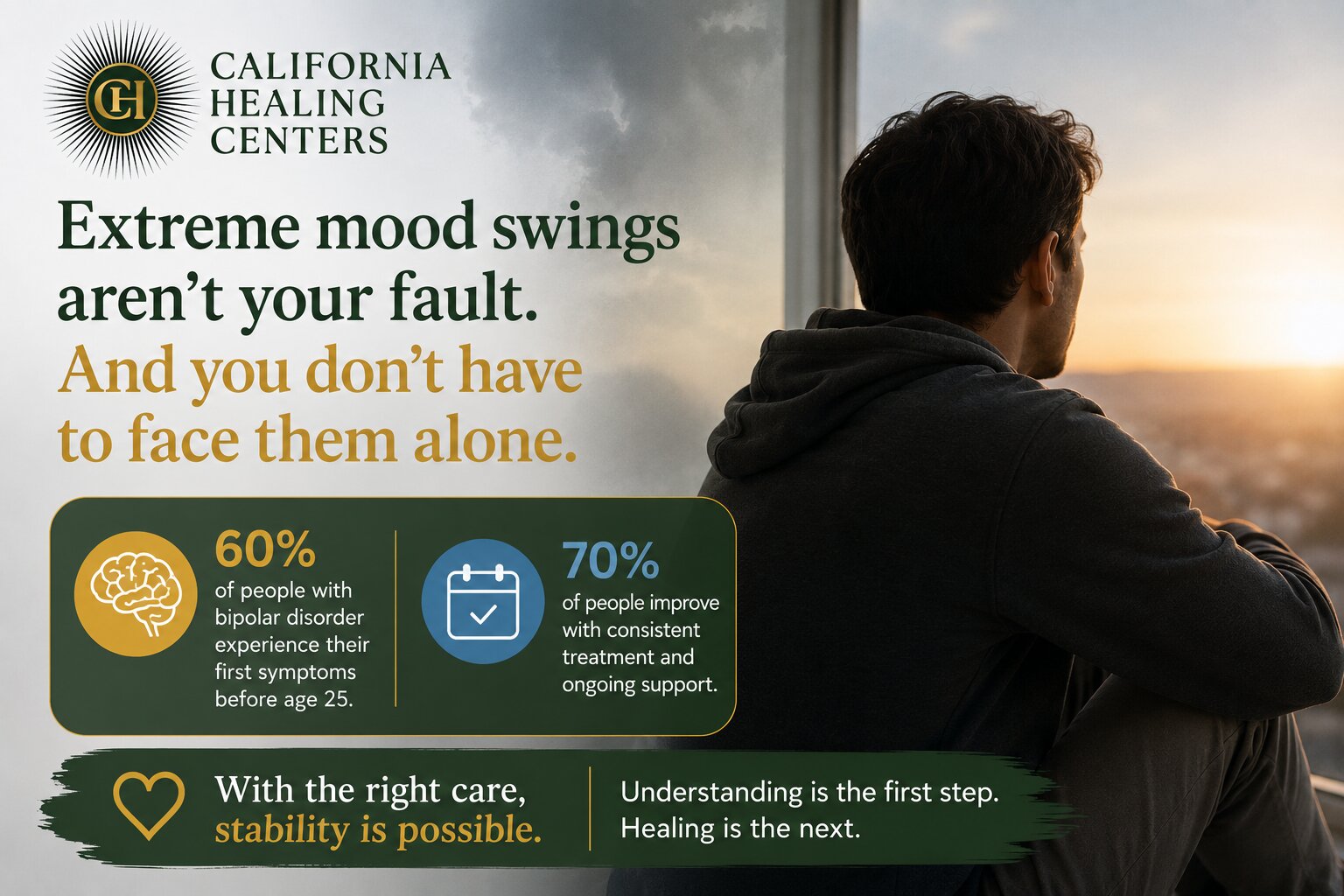
Why Your Energy Swings Feel So Extreme  California Healing

Why People Often Blame Themselves

One of the most painful parts of these experiences is self-criticism.

You may tell yourself:

  • “I just need to be more disciplined.”
  • “Everyone else seems to handle life better.”
  • “I’m probably just lazy.”
  • “Maybe I’m overreacting.”

Those thoughts can become part of the cycle.

When you’re feeling energized, you may criticize yourself for not accomplishing more during the low periods.

When you’re exhausted, you may wonder why you cannot maintain the motivation you had just days earlier.

Over time, the constant self-blame becomes almost as exhausting as the mood changes themselves.

The truth is that significant changes in mood and energy are not character flaws.

They deserve understanding, not judgment.

You Do Not Have to Figure This Out Alone

One common misconception is that you must know exactly what condition you have before asking for help.

That simply is not true.

Mental health professionals are trained to recognize patterns that are often difficult to see while you are living through them.

A thorough evaluation considers:

  • Your mood over time.
  • Changes in sleep.
  • Energy levels.
  • Daily functioning.
  • Relationships.
  • Family history.
  • Physical health.
  • Other mental health concerns.

Sometimes the answer is bipolar disorder.

Sometimes it is another condition with similar symptoms.

Sometimes anxiety, trauma, depression, or substance use can contribute to similar experiences.

The goal is not to place a label on you.

The goal is to understand what is happening so that treatment can be tailored to your unique needs.

Many people also benefit from approaches like Internal Family Systems therapy, which helps people better understand conflicting emotional experiences, or group therapy, where they realize they are far from alone in what they have been experiencing.

Sometimes the greatest relief comes from hearing someone else describe feelings you thought only you had.

Recovery Is About Finding Stability, Not Losing Yourself

One fear keeps many people from reaching out.

They worry treatment will change who they are.

“What if I lose my creativity?”

“What if I lose my personality?”

“What if I never feel excited again?”

Those fears are understandable.

But effective treatment is not about making you emotionally flat.

It is about reducing the painful extremes that leave you feeling out of control.

Think about driving on a road filled with steep hills.

One moment, you’re racing downhill with no brakes.

The next, you’re struggling to climb an impossible incline.

Eventually, you stop enjoying the journey because all of your energy goes into surviving the road itself.

Treatment works toward creating a smoother path.

You still experience joy.

You still experience sadness.

You still have ambitions, passions, and dreams.

The difference is that those emotions begin working with you instead of against you.

You Deserve Answers Before Things Become Worse

Many people wait until they lose a job, damage important relationships, or experience a crisis before seeking help.

It does not have to reach that point.

Recognizing patterns early can make treatment more effective and reduce the impact these changes have on your daily life.

If you’ve been wondering why your energy seems to swing from one extreme to another, trust that question.

Curiosity is not weakness.

It is often the beginning of healing.

The fact that you are searching for answers today may be the first step toward understanding experiences that have felt confusing for a long time.

You deserve compassion.

You deserve clarity.

Most importantly, you deserve support.

Frequently Asked Questions

Can stress cause me to feel super energized and then completely exhausted?

Stress can temporarily affect energy levels and sleep, but repeated cycles of unusually high energy followed by prolonged emotional lows should be evaluated by a mental health professional. Looking at the full pattern over time is important.

Does this automatically mean I have bipolar disorder?

No. Many mental health conditions can share similar symptoms. Only a qualified professional can determine what may be contributing to your experiences after a comprehensive evaluation.

When should I seek professional help?

If these mood changes interfere with work, school, relationships, sleep, or your ability to care for yourself, or if they keep happening despite your efforts to manage them, it is a good idea to seek an assessment.

Can treatment help me feel like myself again?

Many people find that appropriate treatment helps them feel more stable, think more clearly, improve relationships, and regain confidence in managing everyday life.

Is it normal to feel embarrassed about asking for help?

Yes. Many first-time treatment seekers worry about being judged or misunderstood. Mental health professionals understand these concerns and strive to provide compassionate, respectful care without judgment.

What if I’m not sure whether I need treatment?

You do not have to be certain before reaching out. An evaluation is simply a conversation designed to better understand your symptoms and recommend the most appropriate next steps based on your individual needs.

Call (858) 330-4769 or visit our mental health treatment and bipolar disorder services to learn more about our mental health treatment and bipolar disorder services San Diego, CA at California Healing Centers.


Accessibility Toolbar

Some Days You Feel Unstoppable. Other Days Getting Out of Bed Feels Impossible.

For a while, you may have told yourself it was just stress.

Maybe work has been demanding. Maybe you have not been sleeping well. Maybe life simply feels overwhelming.

But eventually, you start noticing that these changes do not happen once in a while—they become a pattern.

There are days when you wake up feeling unstoppable. Your mind moves quickly. You have endless ideas. You feel motivated to tackle projects that have been sitting untouched for months. Sleep seems unnecessary, and your confidence feels higher than usual.

Then, almost without warning, everything shifts.

You cannot get out of bed. Simple tasks feel impossible. Returning a phone call takes more energy than you can find. Friends ask where you've been, but you do not know how to explain what happened.

If you've searched, "Why do I go from super wired to can't get out of bed for days?" you are probably looking for more than information.

You are looking for reassurance that you are not imagining this.

You are looking for someone to tell you that these experiences have a name and that help exists.

At California Healing Centers, we meet many people who spend months—or even years—trying to understand these dramatic changes before reaching out. Learning more about bipolar disorder treatment can be an important step toward understanding what may be happening and discovering that recovery is possible.

It Can Feel Like You Are Becoming Different People

One week, life feels exciting.

Your thoughts come quickly. You feel creative. You finally have the motivation to organize your home, reconnect with friends, make plans, or begin projects that have been waiting for months.

Everything feels possible.

People around you may even compliment your energy.

"You seem happier."

"You've really turned things around."

"You've got so much motivation lately."

Hearing those comments can make it even harder to recognize when something is wrong.

Eventually, the energy becomes difficult to manage.

Your thoughts race faster than you can keep up. Sleeping feels unnecessary. You become restless or impatient. Small inconveniences suddenly feel overwhelming, and you may make decisions that seem perfectly reasonable in the moment but confusing later.

Then comes the opposite extreme.

The same person who felt capable of accomplishing everything yesterday now struggles to shower, answer emails, or even leave the bedroom.

Living this way can feel like constantly switching between two versions of yourself.

Neither one feels completely under your control.

These Changes Are About More Than Feeling Happy or Sad

Many people assume these experiences are simply emotional ups and downs.

They are not.

Everyone experiences stress, excitement, disappointment, and fatigue.

The difference is how intense these periods become and how much they interfere with everyday life.

When your mood affects your ability to work, maintain relationships, sleep normally, or care for yourself, it deserves attention.

The low periods are often misunderstood as laziness.

In reality, many people desperately want to function normally but feel mentally and physically unable to begin even the simplest tasks.

Likewise, the high-energy periods are not always "good days."

While they may initially feel productive or exciting, they can also become exhausting, overwhelming, and difficult to control.

Understanding this difference is important because many people wait years before seeking help simply because they believe they should be able to "snap out of it."

The High-Energy Days Can Hide the Real Problem

When people think about emotional struggles, they usually picture depression.

Few people worry about having too much energy.

That is one reason these experiences often go unnoticed.

During periods of unusually elevated energy, you might:

  • Sleep only a few hours without feeling tired.
  • Talk faster than usual.
  • Feel unusually confident or invincible.
  • Become distracted easily.
  • Start several new projects at once.
  • Spend money impulsively.
  • Make important decisions very quickly.
  • Feel irritated when others cannot keep up with your pace.

At first, those experiences can seem positive.

Friends may admire your productivity.

Coworkers may compliment your enthusiasm.

Family members may believe you're finally feeling better.

What they often do not see is how difficult it becomes to slow your mind down.

Eventually, your body can no longer maintain that pace.

When the energy disappears, it often leaves behind overwhelming exhaustion.

Many people searching for answers eventually discover that experiences involving extreme mood swings adults describe often look very different from popular stereotypes. Rather than dramatic scenes shown in movies, many individuals quietly struggle with changing periods of unusually high energy followed by deep emotional lows that affect every part of daily life.

Why Your Energy Swings Feel So Extreme  California Healing

Why People Often Blame Themselves

One of the most painful parts of these experiences is self-criticism.

You may tell yourself:

  • "I just need to be more disciplined."
  • "Everyone else seems to handle life better."
  • "I'm probably just lazy."
  • "Maybe I'm overreacting."

Those thoughts can become part of the cycle.

When you're feeling energized, you may criticize yourself for not accomplishing more during the low periods.

When you're exhausted, you may wonder why you cannot maintain the motivation you had just days earlier.

Over time, the constant self-blame becomes almost as exhausting as the mood changes themselves.

The truth is that significant changes in mood and energy are not character flaws.

They deserve understanding, not judgment.

You Do Not Have to Figure This Out Alone

One common misconception is that you must know exactly what condition you have before asking for help.

That simply is not true.

Mental health professionals are trained to recognize patterns that are often difficult to see while you are living through them.

A thorough evaluation considers:

  • Your mood over time.
  • Changes in sleep.
  • Energy levels.
  • Daily functioning.
  • Relationships.
  • Family history.
  • Physical health.
  • Other mental health concerns.

Sometimes the answer is bipolar disorder.

Sometimes it is another condition with similar symptoms.

Sometimes anxiety, trauma, depression, or substance use can contribute to similar experiences.

The goal is not to place a label on you.

The goal is to understand what is happening so that treatment can be tailored to your unique needs.

Many people also benefit from approaches like Internal Family Systems therapy, which helps people better understand conflicting emotional experiences, or group therapy, where they realize they are far from alone in what they have been experiencing.

Sometimes the greatest relief comes from hearing someone else describe feelings you thought only you had.

Recovery Is About Finding Stability, Not Losing Yourself

One fear keeps many people from reaching out.

They worry treatment will change who they are.

"What if I lose my creativity?"

"What if I lose my personality?"

"What if I never feel excited again?"

Those fears are understandable.

But effective treatment is not about making you emotionally flat.

It is about reducing the painful extremes that leave you feeling out of control.

Think about driving on a road filled with steep hills.

One moment, you're racing downhill with no brakes.

The next, you're struggling to climb an impossible incline.

Eventually, you stop enjoying the journey because all of your energy goes into surviving the road itself.

Treatment works toward creating a smoother path.

You still experience joy.

You still experience sadness.

You still have ambitions, passions, and dreams.

The difference is that those emotions begin working with you instead of against you.

You Deserve Answers Before Things Become Worse

Many people wait until they lose a job, damage important relationships, or experience a crisis before seeking help.

It does not have to reach that point.

Recognizing patterns early can make treatment more effective and reduce the impact these changes have on your daily life.

If you've been wondering why your energy seems to swing from one extreme to another, trust that question.

Curiosity is not weakness.

It is often the beginning of healing.

The fact that you are searching for answers today may be the first step toward understanding experiences that have felt confusing for a long time.

You deserve compassion.

You deserve clarity.

Most importantly, you deserve support.

Frequently Asked Questions

Can stress cause me to feel super energized and then completely exhausted?

Stress can temporarily affect energy levels and sleep, but repeated cycles of unusually high energy followed by prolonged emotional lows should be evaluated by a mental health professional. Looking at the full pattern over time is important.

Does this automatically mean I have bipolar disorder?

No. Many mental health conditions can share similar symptoms. Only a qualified professional can determine what may be contributing to your experiences after a comprehensive evaluation.

When should I seek professional help?

If these mood changes interfere with work, school, relationships, sleep, or your ability to care for yourself, or if they keep happening despite your efforts to manage them, it is a good idea to seek an assessment.

Can treatment help me feel like myself again?

Many people find that appropriate treatment helps them feel more stable, think more clearly, improve relationships, and regain confidence in managing everyday life.

Is it normal to feel embarrassed about asking for help?

Yes. Many first-time treatment seekers worry about being judged or misunderstood. Mental health professionals understand these concerns and strive to provide compassionate, respectful care without judgment.

What if I'm not sure whether I need treatment?

You do not have to be certain before reaching out. An evaluation is simply a conversation designed to better understand your symptoms and recommend the most appropriate next steps based on your individual needs.

Call (858) 330-4769 or visit our mental health treatment and bipolar disorder services to learn more about our mental health treatment and bipolar disorder services San Diego, CA at California Healing Centers.

Table of Contents
Scroll to Top