
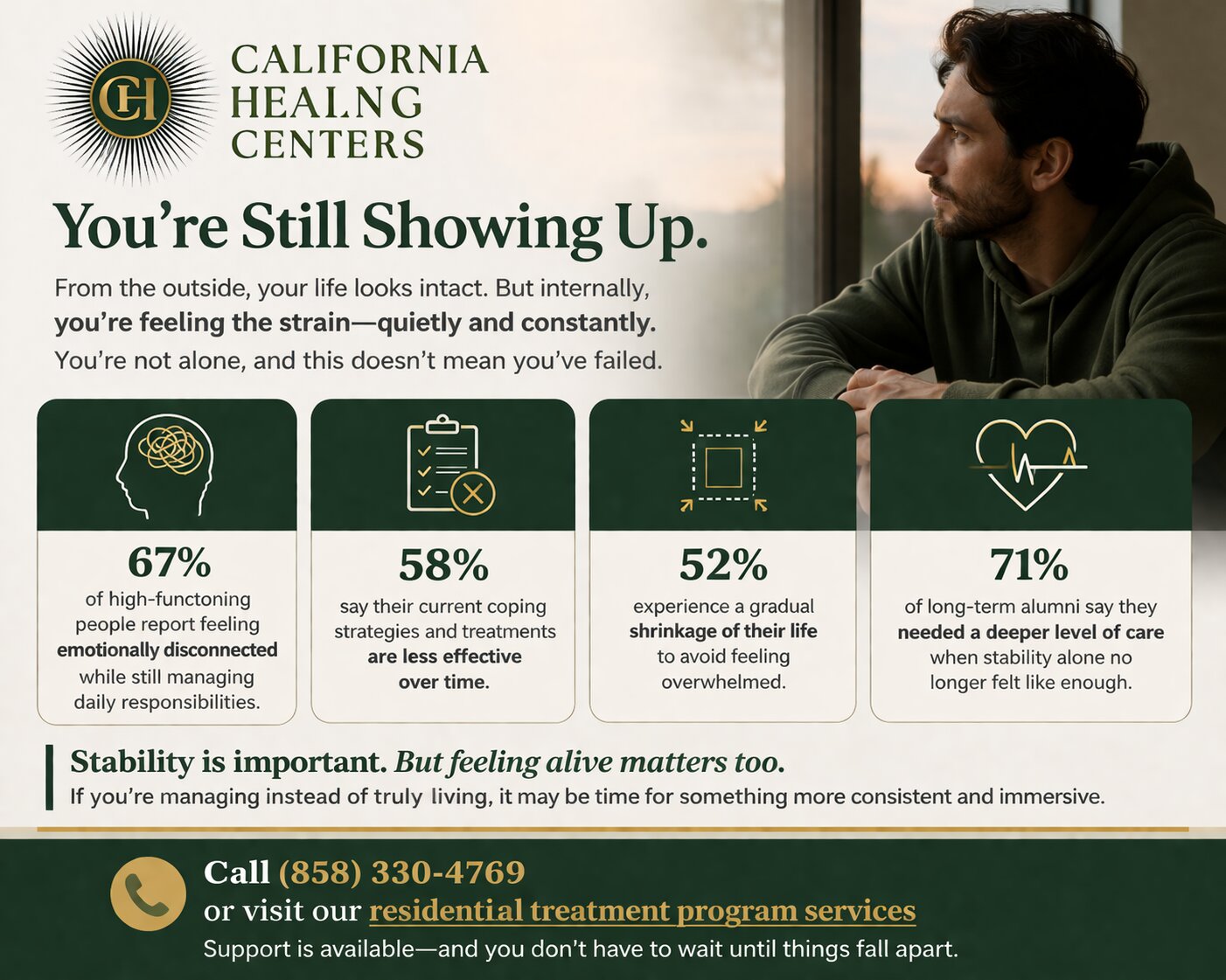
You’re still showing up.
From the outside, your life probably looks intact—maybe even successful. But internally, something has shifted in a way that’s hard to explain and even harder to admit.
And that’s usually where this starts.
You’re Still Holding It Together—But It Feels Fragile
You haven’t stopped functioning.
You’re still answering messages. Still doing what needs to be done. Still carrying responsibilities that don’t pause just because you’re struggling.
But it feels different now.
There’s a tightness behind everything. A constant mental effort just to stay steady. Like you’re balancing something heavy that no one else can see.
You might think, If I can still function, it can’t be that bad.
But here’s the reality:
High-functioning people don’t avoid struggle—they just get better at hiding it.
The Coping Strategies That Used to Work Start Wearing Thin
At some point, you did the right things.
You reached out. You tried therapy. You followed recommendations. Maybe you adjusted your lifestyle, your schedule, your expectations.
And for a while, it helped.
But now it feels like you’ve hit a ceiling.
- Therapy feels repetitive instead of relieving
- Medication feels inconsistent, or like it’s lost its edge
- Coping tools feel like they buy you time—but not real change
This is one of the most frustrating places to be.
Because you’re trying. You’ve been trying.
And it’s not working the way it used to.
Life Quietly Shrinks Around You
This doesn’t happen all at once.
It’s subtle.
You start canceling plans—not dramatically, just here and there. You avoid things that feel overwhelming. You stick to what feels manageable.
Your world gets smaller, but it feels like self-protection.
Until one day, you realize:
You’re not really living your life.
You’re managing your symptoms inside it.
And the gap between those two things keeps growing.
You Begin to Wonder If This Is Just How It Is Now
This thought doesn’t usually come in loud.
It shows up quietly, in moments:
Maybe this is just my baseline now.
Maybe this is as good as it gets.
That’s a heavy place to land.
Because it doesn’t feel like crisis—it feels like resignation.
And resignation is harder to recognize, but just as important to respond to.
The Question Most High-Functioning People Hesitate to Ask
Eventually, another thought starts to form:
Is there something more than this?
Not another tweak.
Not another coping strategy.
Not another “try this and see.”
Something more consistent. More immersive. More stabilizing.
If you’ve found yourself searching for answers around severe depression help options, it usually means you’ve reached a point where your current support isn’t enough anymore.
And that’s not failure.
That’s awareness.
There are levels of care designed specifically for this moment—when things haven’t collapsed, but they’re no longer sustainable either.
You can get a clearer picture of what that looks like through this live-in treatment program, where support happens daily, not just in fragments.
Why People Like You Wait Longer Than You Should
This pattern is incredibly common.
Because you’re still functioning, it’s easy to delay taking the next step.
You might tell yourself:
- “I should be able to handle this.”
- “It’s not bad enough yet.”
- “Other people need this more than I do.”
So you keep pushing.
But here’s the part that’s often overlooked:
The longer you stay in survival mode, the more normalized it becomes.
And what once felt like a temporary struggle starts to feel like your identity.
What Changes When You Stop Doing This Alone
There’s a misconception that more immersive support is only for people in visible crisis.
But for many high-functioning individuals, it feels like something else entirely.
Relief.
For the first time in a long time:
- You’re not juggling everything by yourself
- Your environment supports your mental health instead of draining it
- Care happens consistently, not occasionally
You’re not squeezing healing into the margins of your life anymore.
It becomes the focus.
And that shift matters more than most people expect.
A Story That Might Feel Familiar
We’ve worked with people who looked completely “fine” on paper.
Stable careers. Strong relationships. No obvious signs that anything was wrong.
But internally, they were exhausted.
One person described it like this:
“I didn’t fall apart. I just stopped feeling like myself. And I kept waiting for it to pass—but it didn’t.”
They didn’t come in because everything collapsed.
They came in because nothing was getting better.
And that distinction matters.
This Isn’t About Breaking—It’s About Recognizing the Pattern
There’s a belief that you need to hit a breaking point before you deserve more help.
That’s not true.
Sometimes the clearest sign is this:
You’re doing everything you can… and it’s still not enough.
That’s not weakness.
That’s information.
And it’s worth listening to.
You Don’t Have to Wait Until It Gets Worse
There’s a different way to approach this.
Not reactive. Not crisis-driven.
Responsive.
You can choose to step into a higher level of support before things fully unravel.
Before exhaustion turns into collapse.
Before disconnection turns into something deeper.
That choice doesn’t mean things are “that bad.”
It means you’re paying attention.
FAQ: Questions You Might Be Asking Yourself
Is it normal for therapy and medication to stop working?
Yes, it can happen. Mental health needs can evolve over time, and what once helped may no longer be enough on its own. That doesn’t mean treatment has failed—it may mean you need a different level of support.
Does needing more support mean my condition is getting worse?
Not necessarily. It often means your current tools aren’t meeting your needs anymore. Seeking more consistent care is a proactive step, not a sign of failure.
What does more immersive care actually provide?
It offers daily structure, consistent therapeutic support, and an environment focused entirely on stabilization and healing—rather than trying to manage everything alongside your normal life.
How do I know if I’ve reached that point?
If you feel stuck, exhausted, or like you’re just maintaining instead of improving—even after trying multiple approaches—it may be time to explore other options.
Can high-functioning people really benefit from this level of care?
Absolutely. In fact, many people who seek this type of support are still functioning outwardly but struggling internally in ways that aren’t sustainable long-term.
What happens after this level of care?
Most people step down into structured daytime care or ongoing therapy, continuing to build on the progress they’ve made in a more supported environment.
A Different Way to Think About This
You don’t have to prove how bad things are before you take them seriously.
You don’t have to wait until everything falls apart.
Sometimes, the most important moment is this one—the quiet realization that what you’re doing isn’t working anymore.
If you’re starting to feel that, it’s worth exploring what support could look like beyond what you’ve already tried.
Call (858) 330-4769 or explore our residential treatment program services to learn more about how support can meet you where you are.