
You did the work. You got through something that once felt impossible.
So why does it feel like you’re only halfway back to yourself?
This is the part of the story most people don’t talk about—but we see it all the time.
You Built a Life… But Something Feels Off Inside It
From the outside, things look stable.
You’re functioning. Maybe even succeeding. The chaos that once defined your life is no longer running the show.
But internally?
There’s a quiet distance.
Not pain in the way it used to be. Not crisis.
Just a sense that you’re slightly removed from your own life—like you’re watching it instead of living it.
And that can feel confusing.
Because this was supposed to be the “after.”
Stability Isn’t the Same as Feeling Alive
A lot of people leave treatment with one clear goal: stabilize.
And that matters. It’s foundational.
But here’s what we often see years later:
People achieved stability… and stopped there.
They’re no longer in crisis. But they’re also not fully connected—to themselves, their emotions, or their lives.
It’s like going from a storm to still water… and then realizing the water never started moving again.
Stillness can feel safe.
But too much of it starts to feel like numbness.
The Drift Happens Quietly—Almost Respectfully
No one wakes up one day and says, “I feel disconnected now.”
It’s gradual.
Life gets busy. Responsibilities return. The intensity of healing fades into the background.
You stop checking in with yourself the way you used to.
You rely on old tools, but don’t deepen them.
You cope—but you don’t necessarily grow.
And slowly, your emotional world gets quieter.
Not peaceful. Just… quieter.
“I Thought I’d Feel More by Now”
This is one of the most honest sentences we hear from long-term alumni.
Not said with anger. Usually with confusion.
Because you’ve done so much right.
And yet:
- Joy feels muted
- Connection feels inconsistent
- Motivation feels forced
- Presence feels harder than it should
You’re not falling apart.
But you’re also not fully here.
Why This Doesn’t Mean You Failed
Let’s say this clearly:
This is not failure.
This is what happens when growth pauses.
Most treatment experiences are intense. Focused. Transformative.
But life after treatment requires something different—ongoing engagement, deeper layers, continued evolution.
If that doesn’t happen, people don’t collapse.
They plateau.
And plateaus can last years because they don’t feel urgent enough to address.
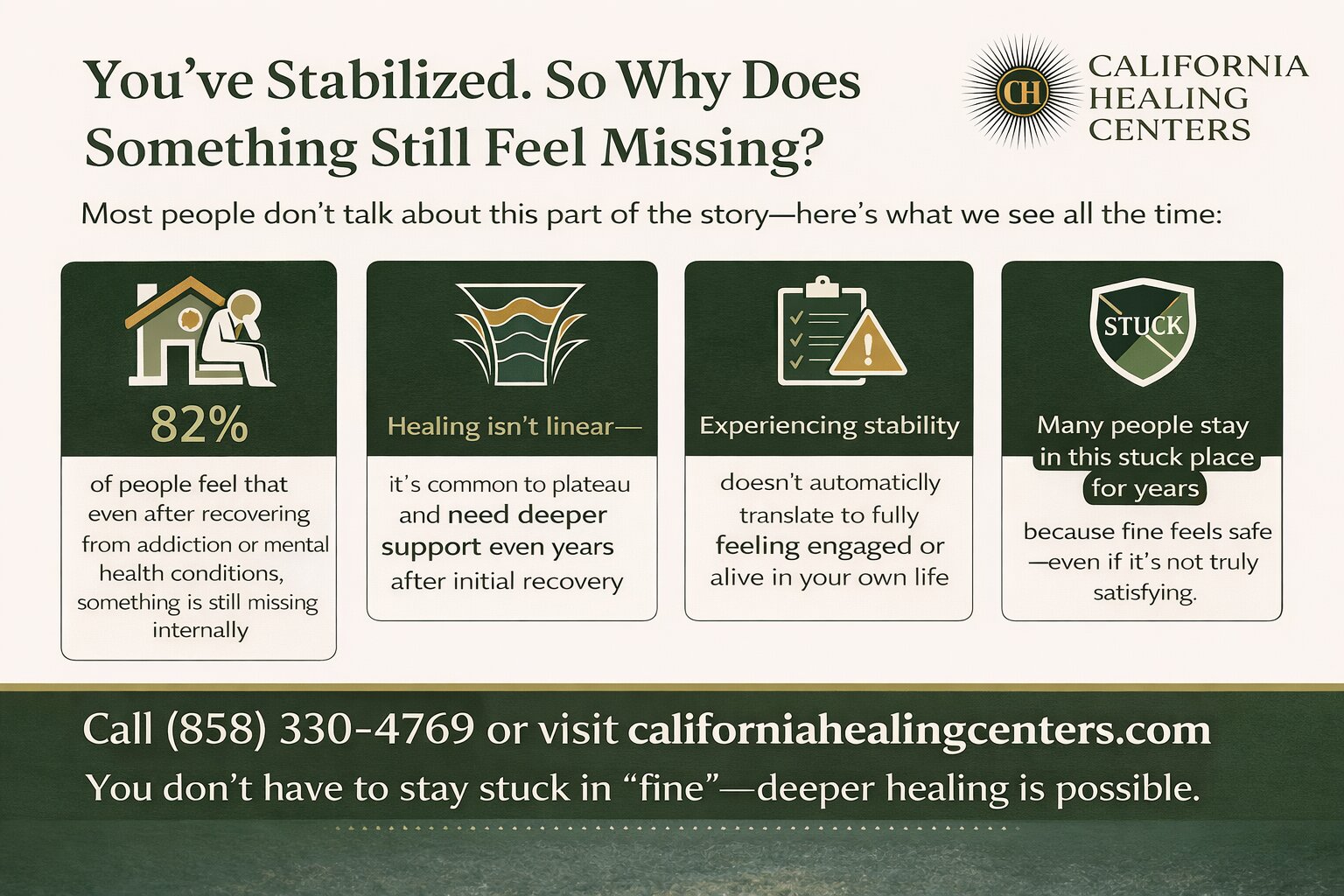
The Difference Between Coping and Living
Coping keeps you stable.
Living requires connection.
A lot of long-term alumni become very good at coping:
- Managing emotions
- Avoiding triggers
- Maintaining routines
But somewhere along the way, they stop asking a different question:
Do I actually feel like myself?
Because coping without connection can start to feel like maintenance.
And maintenance can start to feel like a quiet kind of survival.
When People Start Noticing the Gap
There’s usually a moment.
Not dramatic. Not loud.
Just a realization:
This isn’t how I want to feel long-term.
It might come during a conversation where you feel distant.
Or a moment that should feel meaningful—but doesn’t land.
Or a quiet night where you realize you’ve been on autopilot for a long time.
That moment matters.
Because it’s awareness—not breakdown—that often leads people back to deeper work.
Coming Back Isn’t About Crisis—It’s About Depth
We’ve worked with many people who return years after their initial treatment.
Not because things fell apart.
Because something felt incomplete.
They weren’t chasing stability anymore.
They were looking for depth.
And when they re-engage—especially in more immersive settings like live-in treatment—something shifts.
Not instantly. But meaningfully.
- Emotional range expands again
- Connection starts to feel real—not forced
- Old patterns become clearer, not just managed
- Life feels less like something to maintain and more like something to experience
A Familiar Thought We Hear Often
There’s a sentence we hear more than you’d expect:
“I didn’t realize how disconnected I was until I started feeling again.”
That’s the thing about numbness—it doesn’t always announce itself.
It just becomes your normal.
Until something interrupts it.
You’re Not Starting Over—You’re Picking Up Where You Left Off
This is important.
Returning to deeper support doesn’t erase your progress.
It builds on it.
You’re coming back with:
- More awareness
- More language
- More honesty about what you actually need
Which means the work often goes deeper, not just wider.
Think of it like reopening a conversation you paused—not restarting your entire story.
Why Some People Stay Stuck Here for Years
Because it’s easy to justify.
You’re functioning. You’re not in crisis. Life is “fine.”
And fine is a dangerous place to stay too long.
Because it removes urgency.
You don’t feel bad enough to act.
But you also don’t feel good enough to be fulfilled.
So you stay.
And over time, that becomes your baseline.
A Question Worth Asking Yourself—Honestly
Not as a judgment. Just as reflection:
Are you living your life… or managing it?
Because those are not the same thing.
And if you’re honest, you probably already know which one it feels like.
There’s More Available Than “Fine”
You’re allowed to want more than stability.
You’re allowed to want:
- Emotional depth
- Genuine connection
- A sense of being present in your own life
If you’ve been searching for something like inpatient mental health California, it may not be because things are falling apart.
It may be because something in you recognizes that you’ve plateaued.
And you’re ready for more.
FAQ: What Long-Term Alumni Often Ask (But Don’t Always Say)
Is it normal to feel disconnected years after treatment?
Yes. It’s more common than people realize. Many individuals stabilize after treatment but don’t continue deep emotional work, which can lead to feeling flat or disconnected over time.
Does feeling this way mean I’m getting worse again?
Not necessarily. It often means you’ve plateaued, not regressed. You may need a deeper level of support—not because you’re failing, but because you’re ready for more growth.
Why didn’t I notice this sooner?
Disconnection tends to build slowly. When you’re functioning well externally, it’s easy to overlook internal changes until they become more noticeable.
Can returning to a higher level of care actually help at this stage?
Yes. Many people return not because they’re in crisis, but because they want to reconnect, process deeper layers, and move beyond maintenance into meaningful growth.
What’s different the second time around?
You bring more awareness, honesty, and readiness. That often makes the experience more focused and impactful than the first time.
What if I feel like I “shouldn’t need this anymore”?
That thought is common—but not helpful. Needing support isn’t a step backward. It’s a sign you’re paying attention to what you actually need.
You Don’t Have to Stay Here
There’s a version of your life that feels more connected than this.
More present. More real. More yours.
If something in this resonates, it’s not random.
It’s awareness.
And awareness is usually the first step toward something better.
Call (858) 330-4769 or visit our residential treatment program services to learn more about how support can meet you where you are.