
The Moment I Realized I Didn’t Actually Heal the First Time

I really believed I got it the first time.

I said what I was supposed to say. I opened up—at least enough to be seen as “doing the work.” I followed the structure, participated in groups, and left feeling lighter.

And for a while, it held.

That’s the part that makes this so confusing.

Because when it started slipping again, I didn’t understand why.

I Mistook Relief for Real Healing

The first time I left, everything felt quieter.

My thoughts weren’t as loud. My emotions weren’t as overwhelming. I wasn’t reacting the way I used to.

And I thought—this is it.

But what I didn’t realize is that relief and healing aren’t the same thing.

Relief is what happens when things calm down.
Healing is what happens when you understand why they got loud in the first place.

I left with relief.

But I didn’t stay long enough with the deeper work that healing actually requires.

I Learned How to Cope—But Not How to Stay With Myself

I got really good at coping.

I knew what to do when things felt overwhelming. I had tools. Strategies. Plans.

But here’s what I didn’t learn the first time:

How to sit with myself when nothing was distracting me.

Because coping can still be a form of avoidance—just a more acceptable one.

I stayed busy. Productive. Distracted in ways that looked healthy.

But underneath that?

There was still something unresolved.

The Part I Avoided Was the Part That Actually Mattered

If I’m honest, I knew there were things I wasn’t touching.

Not fully.

The heaviness that didn’t have a clear reason.
The anxiety that hummed in the background even on “good” days.
The moments where I felt disconnected for no obvious cause.

I brushed past those.

Focused on what felt more manageable. More explainable.

But healing doesn’t happen in the parts that feel easy to talk about.

It happens in the parts you’d rather not look at too closely.

When Mental Health and Coping Start Feeding Each Other

This is something I didn’t understand at the time.

I thought I had separate issues.

There was the emotional side—and then there were the ways I coped with it.

But they weren’t separate.

They were feeding each other.

The more disconnected I felt, the more I looked for something to manage that feeling.
The more I relied on coping, the less I understood what I was actually feeling.

It became a loop.

And I was only addressing half of it.

When I finally came back and experienced care that looked at both sides together—what people refer to as dual diagnosis treatment San Diego—it was the first time the full picture made sense.

The Return Wasn’t Dramatic—It Was Quiet

I wish I could say there was a moment where everything clearly fell apart.

There wasn’t.

It was quieter.

I stopped doing the things that helped.
Started isolating more.
Felt more irritated, more tired, more disconnected.

But nothing looked “bad enough” to justify concern.

And that’s what kept me stuck.

Because when things fall apart loudly, people respond.

When they fall apart quietly, you convince yourself you’re fine.

The Shame of Coming Back

Coming back was harder than going the first time.

Not because I didn’t believe in it.

Because I believed I shouldn’t need it again.

That voice is brutal:

You already had your chance.
You should have gotten it right.

But here’s what I’ve learned since:

That voice doesn’t care about your healing.
It only cares about your pride.

And healing doesn’t happen in pride.

It happens in honesty.

The Second Time, I Stopped Trying to Look “Better”

This changed everything.

The first time, I wanted to improve. To be seen as progressing. To move forward.

The second time?

I just wanted to understand.

I stopped rushing.
Stopped filtering what I shared.
Stopped trying to make things make sense before I spoke them out loud.

And for the first time, I stayed in the uncomfortable parts long enough for them to actually shift.
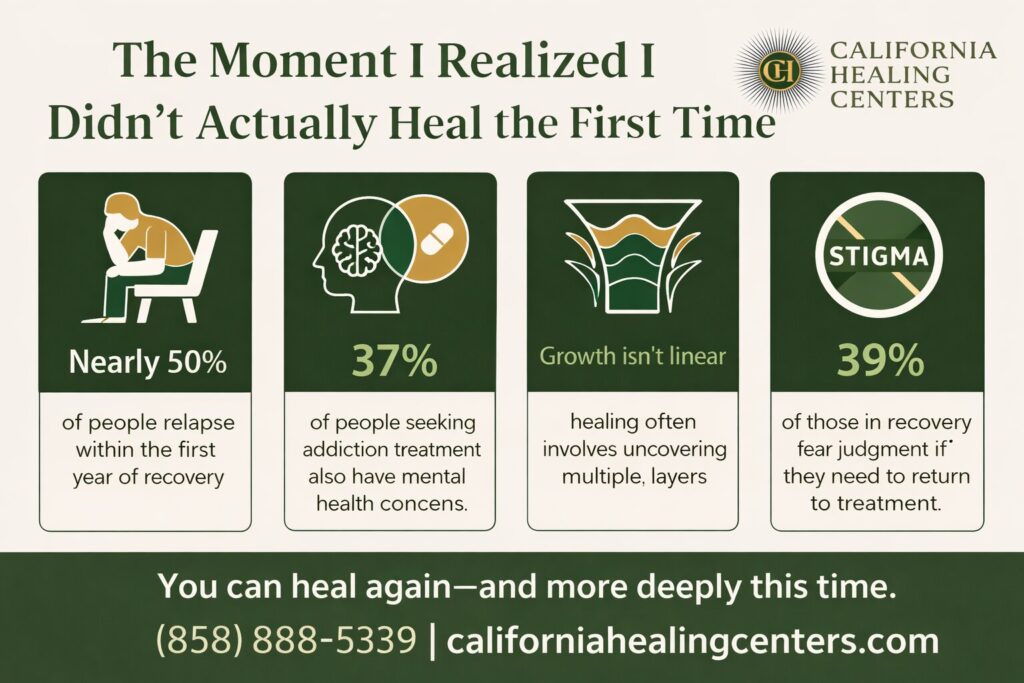
Why Treatment Didn’t Fully Work the First Time

I Realized Growth Isn’t Linear—It’s Layered

This is the part I wish someone had told me earlier.

You don’t heal everything at once.

You uncover it in layers.

The first time, I dealt with what I could see.

The second time, I started understanding what was underneath that.

And maybe there will be more layers after this.

That doesn’t mean something is wrong.

It means you’re going deeper.

The Difference Between “Getting Through” and Actually Changing

The first time, I got through it.

The second time, something actually changed.

Not overnight. Not perfectly.

But in a way that felt more solid.

Less like I was managing myself—and more like I was actually understanding myself.

That’s a completely different experience.

If You Feel Like You Missed Something the First Time

You probably did.

And that’s okay.

Not because you didn’t try.
But because you can only face what you’re ready to face.

Some things don’t make sense until later.

Some patterns don’t become clear until you’ve lived through them again.

That’s not failure.

That’s timing.

You’re Not Back at the Beginning—You’re Coming Back With More Awareness

This matters.

Because it changes how you approach everything.

You’re not starting from zero.

You’re coming back with:

  • More honesty about what’s actually going on
  • More awareness of your patterns
  • Less interest in surface-level fixes

That makes the work different.

Deeper.

More real.

One Truth That Took Me Too Long to Accept

You can do everything “right” and still not be done.

Healing isn’t a one-time event.

It’s something you return to—again and again, in different ways, at different depths.

Once I stopped expecting it to be finished, it actually started to feel more possible.

FAQ: If You’re Thinking About Going Back

Did I fail if I need treatment again?

No. It means you’re recognizing something deeper now than you did before. That’s growth, not failure.

Why did things seem better at first, then get worse again?

Early progress often comes from stabilization. But deeper patterns can resurface if they weren’t fully processed the first time.

How do I know if I missed something important?

If you still feel disconnected, stuck, or like you’re managing more than actually improving—that’s usually a sign there’s more to explore.

Will it actually be different the second time?

Yes—because you’re different. More aware, more honest, and more open to deeper work.

What if I’m ashamed to go back?

That’s normal. But that shame is often the exact thing that keeps people stuck longer than they need to be.

Is it worth addressing both mental health and substance use together?

For many people, yes. When both are connected, treating them together can lead to more lasting change than addressing them separately.

If You’re Here, You’re Already Seeing It

That feeling—that something didn’t fully land the first time?

That’s awareness.

And awareness is where everything starts to shift.

You don’t have to pretend it worked if it didn’t fully.

You don’t have to stay stuck in “almost better.”

Call (858) 330-4769 or visit our residential treatment program services to learn more about what deeper, more complete support can look like.


Leave a Comment

Your email address will not be published. Required fields are marked *

Accessibility Toolbar

The Moment I Realized I Didn’t Actually Heal the First Time

I really believed I got it the first time.

I said what I was supposed to say. I opened up—at least enough to be seen as “doing the work.” I followed the structure, participated in groups, and left feeling lighter.

And for a while, it held.

That’s the part that makes this so confusing.

Because when it started slipping again, I didn’t understand why.

I Mistook Relief for Real Healing

The first time I left, everything felt quieter.

My thoughts weren’t as loud. My emotions weren’t as overwhelming. I wasn’t reacting the way I used to.

And I thought—this is it.

But what I didn’t realize is that relief and healing aren’t the same thing.

Relief is what happens when things calm down.
Healing is what happens when you understand why they got loud in the first place.

I left with relief.

But I didn’t stay long enough with the deeper work that healing actually requires.

I Learned How to Cope—But Not How to Stay With Myself

I got really good at coping.

I knew what to do when things felt overwhelming. I had tools. Strategies. Plans.

But here’s what I didn’t learn the first time:

How to sit with myself when nothing was distracting me.

Because coping can still be a form of avoidance—just a more acceptable one.

I stayed busy. Productive. Distracted in ways that looked healthy.

But underneath that?

There was still something unresolved.

The Part I Avoided Was the Part That Actually Mattered

If I’m honest, I knew there were things I wasn’t touching.

Not fully.

The heaviness that didn’t have a clear reason.
The anxiety that hummed in the background even on “good” days.
The moments where I felt disconnected for no obvious cause.

I brushed past those.

Focused on what felt more manageable. More explainable.

But healing doesn’t happen in the parts that feel easy to talk about.

It happens in the parts you’d rather not look at too closely.

When Mental Health and Coping Start Feeding Each Other

This is something I didn’t understand at the time.

I thought I had separate issues.

There was the emotional side—and then there were the ways I coped with it.

But they weren’t separate.

They were feeding each other.

The more disconnected I felt, the more I looked for something to manage that feeling.
The more I relied on coping, the less I understood what I was actually feeling.

It became a loop.

And I was only addressing half of it.

When I finally came back and experienced care that looked at both sides together—what people refer to as dual diagnosis treatment San Diego—it was the first time the full picture made sense.

The Return Wasn’t Dramatic—It Was Quiet

I wish I could say there was a moment where everything clearly fell apart.

There wasn’t.

It was quieter.

I stopped doing the things that helped.
Started isolating more.
Felt more irritated, more tired, more disconnected.

But nothing looked “bad enough” to justify concern.

And that’s what kept me stuck.

Because when things fall apart loudly, people respond.

When they fall apart quietly, you convince yourself you’re fine.

The Shame of Coming Back

Coming back was harder than going the first time.

Not because I didn’t believe in it.

Because I believed I shouldn’t need it again.

That voice is brutal:

You already had your chance.
You should have gotten it right.

But here’s what I’ve learned since:

That voice doesn’t care about your healing.
It only cares about your pride.

And healing doesn’t happen in pride.

It happens in honesty.

The Second Time, I Stopped Trying to Look “Better”

This changed everything.

The first time, I wanted to improve. To be seen as progressing. To move forward.

The second time?

I just wanted to understand.

I stopped rushing.
Stopped filtering what I shared.
Stopped trying to make things make sense before I spoke them out loud.

And for the first time, I stayed in the uncomfortable parts long enough for them to actually shift.

Why Treatment Didn’t Fully Work the First Time

I Realized Growth Isn’t Linear—It’s Layered

This is the part I wish someone had told me earlier.

You don’t heal everything at once.

You uncover it in layers.

The first time, I dealt with what I could see.

The second time, I started understanding what was underneath that.

And maybe there will be more layers after this.

That doesn’t mean something is wrong.

It means you’re going deeper.

The Difference Between “Getting Through” and Actually Changing

The first time, I got through it.

The second time, something actually changed.

Not overnight. Not perfectly.

But in a way that felt more solid.

Less like I was managing myself—and more like I was actually understanding myself.

That’s a completely different experience.

If You Feel Like You Missed Something the First Time

You probably did.

And that’s okay.

Not because you didn’t try.
But because you can only face what you’re ready to face.

Some things don’t make sense until later.

Some patterns don’t become clear until you’ve lived through them again.

That’s not failure.

That’s timing.

You’re Not Back at the Beginning—You’re Coming Back With More Awareness

This matters.

Because it changes how you approach everything.

You’re not starting from zero.

You’re coming back with:

  • More honesty about what’s actually going on
  • More awareness of your patterns
  • Less interest in surface-level fixes

That makes the work different.

Deeper.

More real.

One Truth That Took Me Too Long to Accept

You can do everything “right” and still not be done.

Healing isn’t a one-time event.

It’s something you return to—again and again, in different ways, at different depths.

Once I stopped expecting it to be finished, it actually started to feel more possible.

FAQ: If You’re Thinking About Going Back

Did I fail if I need treatment again?

No. It means you’re recognizing something deeper now than you did before. That’s growth, not failure.

Why did things seem better at first, then get worse again?

Early progress often comes from stabilization. But deeper patterns can resurface if they weren’t fully processed the first time.

How do I know if I missed something important?

If you still feel disconnected, stuck, or like you’re managing more than actually improving—that’s usually a sign there’s more to explore.

Will it actually be different the second time?

Yes—because you’re different. More aware, more honest, and more open to deeper work.

What if I’m ashamed to go back?

That’s normal. But that shame is often the exact thing that keeps people stuck longer than they need to be.

Is it worth addressing both mental health and substance use together?

For many people, yes. When both are connected, treating them together can lead to more lasting change than addressing them separately.

If You’re Here, You’re Already Seeing It

That feeling—that something didn’t fully land the first time?

That’s awareness.

And awareness is where everything starts to shift.

You don’t have to pretend it worked if it didn’t fully.

You don’t have to stay stuck in “almost better.”

Call (858) 330-4769 or visit our residential treatment program services to learn more about what deeper, more complete support can look like.

Table of Contents
Scroll to Top