
You feel calmer when one particular person texts you back.
When they seem distant, your entire day changes.
You replay conversations, worry you’ve done something wrong, and feel overwhelming relief the moment they reassure you that everything is okay.
If this sounds familiar, you may have come across the term favorite person BPD while trying to understand your relationships.
Although “favorite person” (often shortened to FP) is not an official mental health diagnosis or DSM-5 term, it is a phrase widely used within the borderline personality disorder (BPD) community to describe an intensely significant attachment to one person. For many people, that relationship becomes a central source of emotional stability—but also intense emotional pain.
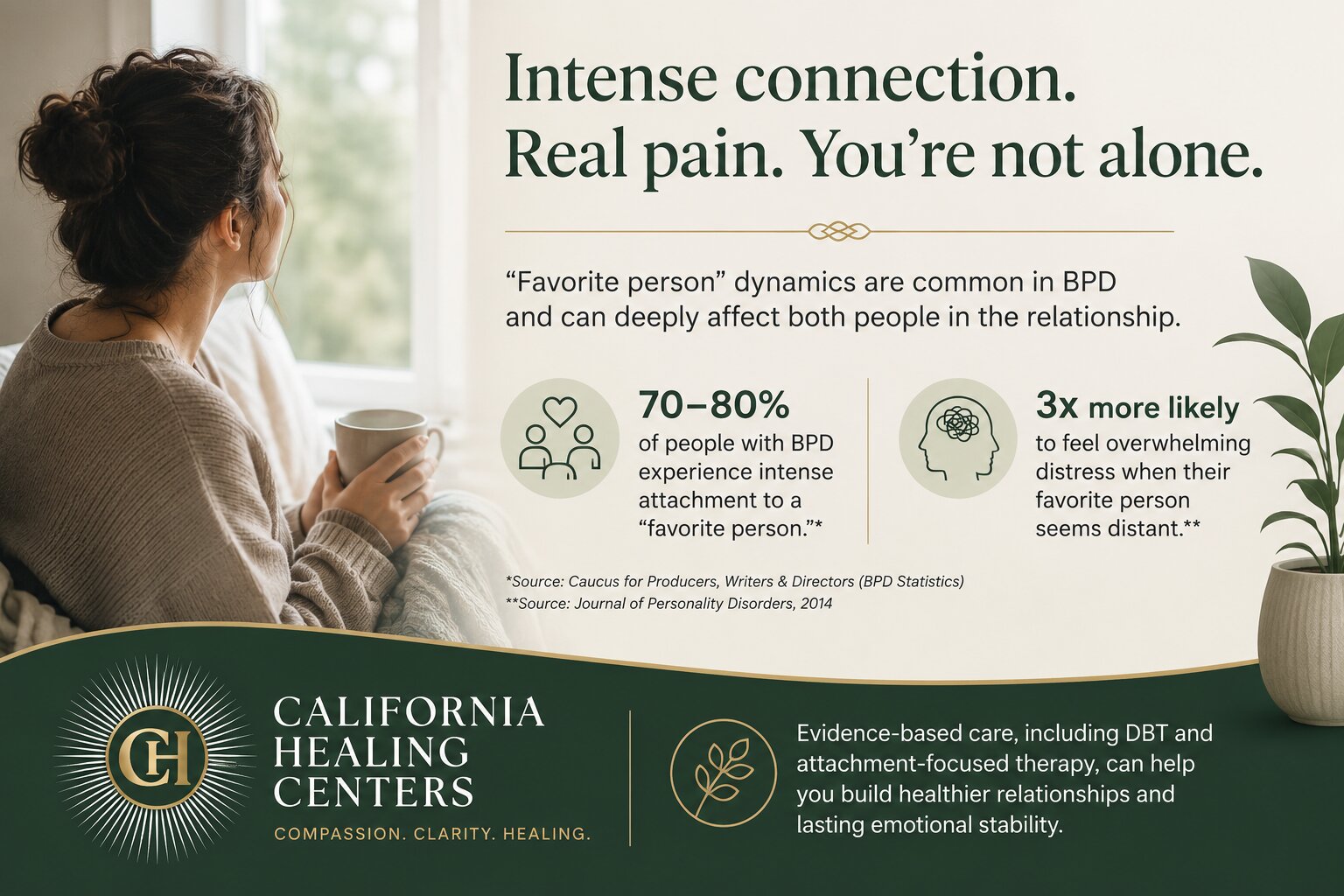
If these attachment patterns are disrupting relationships or daily functioning, evidence-based borderline personality disorder treatment can help address the underlying emotional and interpersonal challenges that drive them. At California Healing Centers in Rancho Santa Fe, treatment combines Dialectical Behavior Therapy (DBT), attachment-informed care, and individualized residential support to help clients build healthier, more secure relationships.
What a “Favorite Person” Is in BPD
A favorite person is someone who becomes emotionally central to another person’s life.
That individual might be:
- A romantic partner
- A close friend
- A spouse
- A family member
- A therapist
- Occasionally even someone who is not especially close
The relationship is not simply about liking or loving someone deeply.
Instead, the favorite person often becomes the primary source of reassurance, validation, emotional safety, and stability.
When interactions with that person feel positive, emotions may improve dramatically.
When communication changes—or even appears to change—intense distress can quickly follow.
It’s important to remember that this pattern is not a character flaw or a sign that someone loves “too much.” Rather, it reflects underlying difficulties with emotional regulation, attachment, and fear of abandonment that are common features of borderline personality disorder.
How the FP Attachment Forms
There is no single reason why someone becomes a favorite person.
The attachment usually develops gradually as the relationship begins to feel emotionally safe, validating, or deeply meaningful.
For many people with BPD, early attachment experiences, emotional invalidation, trauma, or inconsistent relationships may contribute to heightened sensitivity around connection and loss.
When someone provides comfort, acceptance, or understanding, the relationship can begin carrying enormous emotional weight.
Over time, the favorite person may become someone whose:
- Approval feels essential
- Attention feels emotionally regulating
- Absence feels overwhelming
- Reassurance becomes difficult to function without
None of this happens because the individual wants to create an unhealthy relationship.
It develops because the nervous system increasingly relies on one relationship to manage emotional distress.
Signs of a Favorite Person Relationship
Every relationship is unique, but certain patterns commonly appear.
Emotional highs and lows tied to one person
A single text message—or the lack of one—can dramatically influence mood.
Small changes in communication may feel much larger than they objectively are.
Fear of abandonment
Many people become highly sensitive to signs that the relationship might change.
Examples include:
- Delayed replies
- Changes in tone
- Cancelled plans
- Increased independence from the other person
Even when there is no evidence the relationship is ending, the fear can feel immediate and intense.
Idealization
The favorite person may initially seem uniquely understanding, supportive, or emotionally safe.
While appreciation itself is healthy, idealization can place unrealistic expectations on both people in the relationship.
Frequent reassurance seeking
The person may repeatedly ask questions such as:
- “Are you upset with me?”
- “Do you still care about me?”
- “Did I do something wrong?”
The reassurance often provides relief—but only temporarily.
Difficulty tolerating distance
Normal separations, busy schedules, or independent activities can feel emotionally painful rather than simply disappointing.
Why It Is Painful for Both the Person with BPD and the FP
The term “favorite person” can sound positive.
In reality, the dynamic is often emotionally exhausting for everyone involved.
For the person experiencing BPD symptoms, the relationship may feel like the only place where emotional safety exists.
That creates enormous pressure.
Minor misunderstandings can become overwhelming because they seem to threaten the entire relationship.
For the favorite person, the experience can also be difficult.
They may genuinely care deeply while feeling uncertain about how to respond to repeated reassurance seeking, emotional intensity, or fears of abandonment.
Neither person is necessarily doing something wrong.
The difficulty lies in the pattern itself.
Without support, both individuals may become trapped in a cycle where reassurance briefly reduces anxiety but unintentionally reinforces the fear that the relationship is constantly at risk.
Why Reassurance Doesn’t Solve the Problem
One of the most confusing aspects of favorite person dynamics is that reassurance genuinely helps—but only for a short time.
A reassuring message may calm fears for minutes or hours.
Soon afterward, uncertainty often returns.
This happens because the underlying difficulty is not simply a lack of information.
It is difficulty tolerating uncertainty and regulating intense emotional responses independently.
As a result, reassurance becomes a temporary solution rather than a lasting one.
Treatment focuses on strengthening internal emotional regulation so that security no longer depends entirely on another person’s responses.
How DBT and Therapy Help Break the Cycle
The goal of treatment is not to eliminate close relationships.
Healthy attachment is an important part of emotional well-being.
Instead, therapy helps individuals build relationships that are secure, balanced, and sustainable.
Dialectical Behavior Therapy (DBT)
DBT is one of the most effective treatments for borderline personality disorder.
It teaches practical skills including:
- Emotion regulation
- Distress tolerance
- Mindfulness
- Interpersonal effectiveness
These skills help reduce the emotional intensity that often fuels favorite person dynamics.
Attachment-focused therapy
Therapy can help individuals understand how earlier relationship experiences influence current attachment patterns.
Developing greater self-awareness often makes it easier to form healthier, more secure relationships.
Building multiple sources of support
Recovery often involves expanding emotional support beyond one relationship.
Healthy friendships, family connections, hobbies, and therapeutic relationships all contribute to greater resilience.
Strengthening self-identity
Many people with BPD describe feeling uncertain about who they are outside of important relationships.
Therapy helps individuals develop a stronger sense of identity that is less dependent on external validation.
For individuals whose symptoms are significantly affecting relationships, emotional stability, or daily functioning, residential treatment offers the opportunity to practice these skills every day. At California Healing Centers, DBT, attachment-focused therapy, and individualized clinical care are integrated throughout the residential experience, allowing clients to receive consistent support as they build healthier relationship patterns.
What Treatment Looks Like at California Healing Centers
California Healing Centers provides individualized residential treatment for adults living with borderline personality disorder and other complex mental health conditions.
Treatment plans are tailored to each client’s needs and may include:
- Comprehensive psychiatric evaluation
- Individual psychotherapy
- Dialectical Behavior Therapy (DBT)
- Cognitive Behavioral Therapy (CBT)
- Attachment-informed therapy
- Group therapy
- Medication management when appropriate
- Mindfulness practices
- Family involvement when clinically appropriate
- Individualized aftercare planning
Located in Rancho Santa Fe in San Diego County, California Healing Centers offers a structured residential environment where clients can step away from the relationship patterns that may be maintaining emotional distress and focus on developing healthier ways of connecting with themselves and others.
Loving Deeply Doesn’t Mean You’re Broken
Many people who search for information about favorite person dynamics feel ashamed.
They worry they are “too much,” “too needy,” or incapable of having healthy relationships.
Those beliefs often create as much pain as the attachment itself.
The truth is that intense attachment patterns are understandable responses to emotional vulnerability—not evidence that you are incapable of healthy love.
With effective treatment, it is possible to build relationships that remain deeply meaningful without becoming the sole source of emotional stability.
Recovery is not about loving less.
It is about learning to feel secure enough that love no longer has to carry the weight of your entire emotional world.
Frequently Asked Questions
What does “favorite person” mean in BPD?
A favorite person is an informal term used to describe someone who becomes an especially significant source of emotional support and validation for a person with borderline personality disorder. Although the term is widely used, it is not an official clinical diagnosis.
Is having a favorite person healthy?
Not necessarily. Caring deeply about someone is healthy, but when one relationship becomes the primary source of emotional stability, it can create distress for both people involved. Therapy can help develop more balanced attachment patterns while maintaining meaningful relationships.
Can favorite person dynamics be managed with treatment?
Yes. Treatments such as Dialectical Behavior Therapy (DBT), attachment-focused therapy, and other evidence-based approaches can help improve emotional regulation, reduce fear of abandonment, and support healthier interpersonal relationships.
Does everyone with BPD have a favorite person?
No. While many people with borderline personality disorder relate to the concept, not everyone experiences a favorite person dynamic. BPD affects individuals differently, and relationship patterns vary from person to person.