If you’ve ever searched “is bipolar a personality disorder” and landed somewhere that just said no — this post answers the follow-on question: what is it, then, and why does the classification matter?
Bipolar disorder is a mood disorder. But that label carries more clinical weight than it might initially seem — and understanding it matters for getting the right diagnosis, the right treatment, and the right expectations about recovery.
The Direct Answer: Yes, Bipolar Is a Mood Disorder
In the DSM-5 (the Diagnostic and Statistical Manual of Mental Disorders, Fifth Edition), bipolar disorder falls under its own chapter: “Bipolar and Related Disorders.” This chapter sits deliberately between the chapters on schizophrenia spectrum disorders and depressive disorders — a placement that reflects bipolar disorder’s unique position as a bridge between psychotic and depressive illness.
As a mood disorder, bipolar disorder’s defining feature is a disturbance in emotional state, specifically, episodes of mania or hypomania alongside episodes of depression. The mood shifts are episodic, which is one of the key features that distinguishes it from personality disorders.
What Does “Mood Disorder” Actually Mean?
Mood disorders are conditions in which the primary pathology is a disturbance of mood — how a person feels emotionally — rather than thought, personality, perception, or cognition (though all of these can be secondarily affected).
The major categories of mood disorder include:
- Depressive disorders (major depressive disorder, persistent depressive disorder, seasonal affective disorder)
- Bipolar and related disorders (Bipolar I, Bipolar II, cyclothymic disorder)
What unites these conditions is that mood is the central, defining symptom — not personality patterns, not psychotic features, not anxiety.
Bipolar vs. Personality Disorder — The Key Differences
This is where the classification confusion most commonly arises, particularly around Borderline Personality Disorder (BPD), which shares some surface-level features with bipolar disorder.
The core distinction:
- Personality disorders involve enduring, pervasive patterns of inner experience and behavior that are stable across time and contexts — they are traits, not episodes
- Bipolar disorder involves distinct episodes of mania, hypomania, and depression, with periods of relative stability in between — it is episodic, not continuous
In BPD, mood shifts tend to be triggered by interpersonal events and last hours. In bipolar disorder, mood episodes last days to weeks and may occur without an obvious external trigger.
This distinction matters enormously for treatment. Confusing the two leads to misdiagnosis — and misdiagnosis leads to the wrong treatment. Antidepressants prescribed without a mood stabilizer in unrecognized bipolar disorder, for example, can trigger manic episodes.
For a deeper look at this distinction, see our post on whether bipolar is a personality disorder.
Types of Bipolar Disorder — The Full Spectrum
Bipolar disorder is not a single condition but a spectrum, and the distinctions matter for treatment planning:
Bipolar I
Defined by the presence of at least one full manic episode — elevated or irritable mood, increased energy, decreased need for sleep, grandiosity, impulsive behavior — lasting at least 7 days, or less if hospitalization is required. Most people with Bipolar I also experience depressive episodes, though depression is not technically required for the diagnosis.
Bipolar II
Defined by hypomanic episodes (less severe than full mania — no psychosis, no hospitalization required) alongside major depressive episodes. Bipolar II is frequently misdiagnosed as unipolar depression because the hypomania is often not recognized as pathological — it can feel like productivity or simply “feeling good.”
Cyclothymic Disorder
A milder, chronic form of mood cycling with hypomanic and depressive symptoms that don’t meet full criteria for Bipolar I or II. Symptoms persist for at least two years in adults. Despite being “milder,” cyclothymia significantly affects quality of life and carries risk of progression to full bipolar disorder.
Other Specified Bipolar Disorder
Used when a clinician observes bipolar-like features that cause significant distress or impairment but don’t fully meet criteria for any of the above — an important category that prevents undertreating real illness.
Can You Have Bipolar and a Personality Disorder at the Same Time?
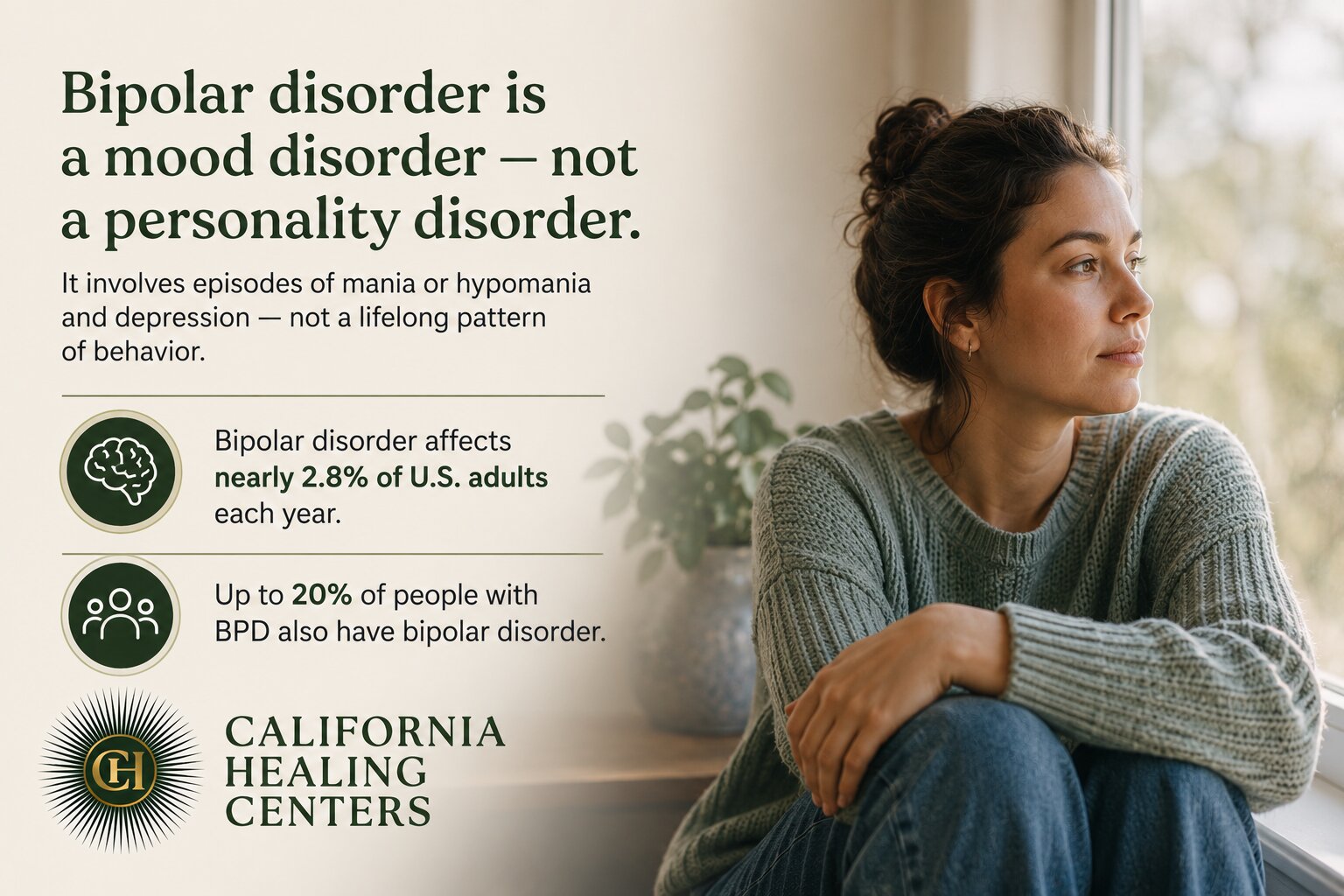
Yes. Co-occurrence is not only possible but relatively common. Bipolar disorder and BPD co-occur in an estimated 10–20% of people with BPD, and the combination significantly complicates both diagnosis and treatment.
When both are present, treatment must address both — which requires a provider experienced in complex, co-occurring presentations. Treating only one while missing the other leads to partial response at best.
How the Mood Disorder Classification Shapes Treatment
The classification isn’t academic — it directly governs what treatment looks like.
Because bipolar disorder is a mood disorder driven by neurobiological dysregulation of mood cycling, the pharmacological backbone of treatment is:
- Mood stabilizers (lithium, valproate, lamotrigine) — first-line for preventing mood episodes
- Atypical antipsychotics — for acute mania and, in some cases, maintenance
- Antidepressants used cautiously — may be appropriate for bipolar depression in some cases but can trigger mania when used without a mood stabilizer
On the psychotherapy side, approaches proven effective for bipolar disorder include:
- Cognitive Behavioral Therapy (CBT): Helps identify early warning signs of mood episodes, builds coping strategies, and addresses the cognitive distortions common during both manic and depressive states
- Dialectical Behavior Therapy (DBT): Particularly effective for emotional regulation — a core challenge in bipolar disorder. Learn more about DBT therapy at California Healing Centers.
- Interpersonal and Social Rhythm Therapy (IPSRT): Stabilizes daily routines, which directly stabilizes mood in bipolar disorder
For more on what a comprehensive approach to bipolar disorder looks like, visit our bipolar disorder treatment page.
Getting the Right Diagnosis and Care
Bipolar disorder requires more than a label — it requires a treatment plan calibrated to where you are in the mood cycle, what co-occurring conditions are present, and what you need to stabilize and rebuild. Misdiagnosis is common, and the consequences are real.
At California Healing Centers, our psychiatric team provides comprehensive bipolar evaluation and individualized care in a residential setting. We take the time to understand the full clinical picture — including co-occurring conditions, medication history, and psychosocial factors — before building a treatment plan.
Learn about our residential program or speak with our team to take the first step.